The way people search is changing fast. Instead of scrolling through ten blue links, users now ask one question and get one answer, straight from Google AI Overviews, Bing Copilot, or a chat tool like ChatGPT. Answer engine optimisation is how you make sure your brand sits behind that answer, even when nobody clicks through to your site. You might see this called answer engine optimization, AEO, or aeo answer engine optimisation. They all point to the same goal: getting your content trusted enough to be quoted.

Users increasingly ask AI assistants direct questions and expect one clear answer, not a list of links.
What Is Answer Engine Optimisation?
Answer engine optimisation means structuring your content so AI systems can read it, trust it, and use it as a direct answer. That is the AEO meaning in one line. If you see the US spelling, answer engine optimization, it points to the exact same practice.
Why it matters right now:
- More searches end without a single click.
- AI systems favour clear entities, firm facts, and strong trust signals.
- Pages that are easy to quote and easy to check get picked more often.
AEO sits close to generative engine optimisation (GEO), but AEO is more answer-first. It is built for direct replies, short summaries, and citations, not just a spot in a results feed.
Traditional SEO vs AI Search
Traditional SEO vs AI search is not a clean break. It is an evolution of the same work.
What still matters:
- Technical health: crawlability, site speed, indexing
- Topical fit between your content and what people search for
- Ecommerce SEO fundamentals, including optimised product, category, and supporting content
- Trust and authority built over time
What changes with answer engines:
- Format carries more weight. Short definitions, numbered steps, tables, and FAQs perform well.
- Clear entities matter more than exact-match keywords.
- Pages that are simple to quote, verify, and trust get pulled into the answer.
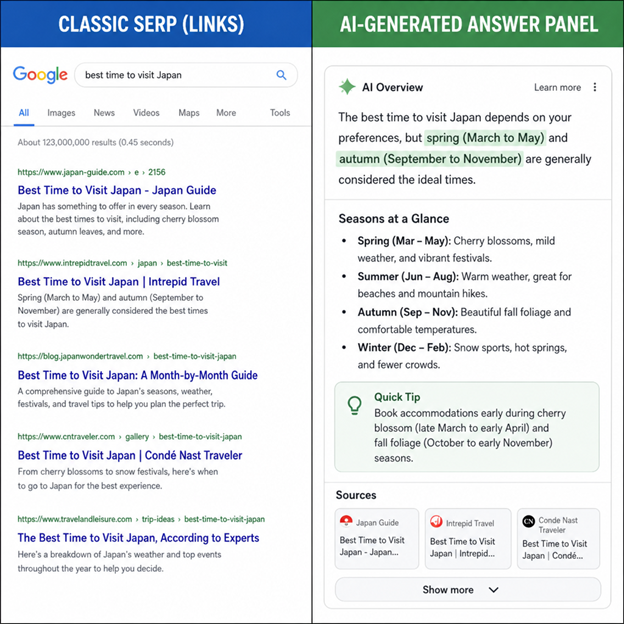
Classic search results list links to click. AI Overviews answer the question directly and cite their sources.
How Answer Engines Choose Sources
Answer engines pull from many pages at once, but a few patterns come up again and again. You can improve your odds with these signals:
- Clear question-and-answer structure
- Strong entity coverage
- Consistent terminology across your site
- Evidence and references that back up your claims
- Freshness, with visible update notes
- Structured data the system can read directly
This is the foundation of any solid AI search optimisation approach. Get these right and you are helping both the AI model and the person reading your page.
Chat-Style Query Keyword Research
AEO starts with chat-style query keyword research: finding the actual questions people type into a chat tool, in plain language, not just short-tail keywords.
Here is how to do it:
- Group queries by intent:
- “What is…” for definitions
- “How do I…” for step-by-step guides
- “Which is better…” for comparisons
- “Best…” for ranked picks with clear rules
- “Can I / Should I…” for decision support
- Build whole pages around a question group, not a single keyword.
- Add assistant-style prompts your page should answer, like “explain simply,” “give me a checklist,” or “summarise in three points.”
A format that works well for answer engines:
- The question as an H2 heading
- A one-sentence direct answer straight after
- Three to seven supporting bullet points
- An optional small table for criteria or comparisons
Snippet-Ready Formats That Also Work in AI Answers
Even in an AI-first search world, the old featured snippet playbook still helps. AI systems often learn from pages that were already snippet-ready.
Use these formats:
- Definition box: 40 to 60 words, plain language, no sales pitch
- Numbered steps: one action per step
- Comparison tables: simple columns, matching units
- Pros and cons lists: built on clear, stated rules
- FAQ blocks: short answers with no repeated ground
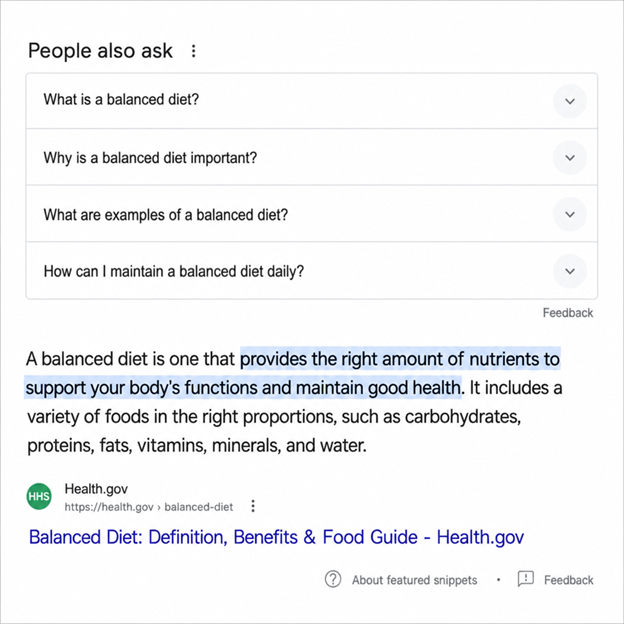
Featured snippets and People Also Ask boxes reward the same clear, structured answers that AI systems look for.
Structured Data for AI Results: What to Do First
If you want AI systems to read your site with less guesswork, start with structured data for AI results. Schema does not guarantee your page gets picked, but it removes doubt about what your content actually is.
Start with:
- Organization, Website, and WebPage schema
- Article or BlogPosting schema
- BreadcrumbList
- Product and Offer schema for ecommerce pages
- FAQPage or QAPage where it genuinely fits
Schema Markup for Q&A Pages
Schema markup for Q&A pages works best when you already have real question-and-answer content, like support docs, help centres, and knowledge bases. Keep it honest:
- Only mark up questions and answers that are visible to users.
- Skip copied or padded FAQ sections.
- Make each answer specific and genuinely useful.
A simple rule to follow: if you mark up five questions, show five real questions with real, useful answers.
Semantic SEO and an Entity-Based Content Strategy
Answer engines work on entities and the relationships between them. That is why semantic SEO for knowledge graphs and a proper entity-based content strategy sit at the core of AEO.
Practical steps:
- Build a topic entity map:
- Core entity: your product or service group
- Supporting entities: use cases, industries, locations, standards, tools
- Use consistent terms for:
- Your brand name
- Key people at your company
- Products, SKUs, and service plans
- Add entity anchors across your site:
- An About page with a clear, specific position
- Author bios that show real expertise
- Glossary pages for the terms that matter in your industry
This makes your pages easier for an AI system to read, sort, and cite correctly.

Mapping how your brand connects to your services and topics helps AI systems understand your site as a whole.
How to Optimise for AI Answers: A Practical On-Page Checklist
If you are wondering how to optimise for AI answers, an ecommerce SEO agency can run this checklist on every page that matters:
- Put the direct answer in the first one to two paragraphs.
- Use headings phrased as real questions.
- Add a “key takeaways” list near the top.
- Include at least one checklist, table, or step-by-step flow.
- Write tight: short sentences, no vague claims, define acronyms the first time you use them.
- Strengthen trust signals: author name and credentials, a last-updated date where it matters, and links to sources or internal proof.
Platform-Specific Optimisation: Google SGE, Bing Copilot, and ChatGPT Citations
Different systems pull content in different ways, so it pays to tune your pages for each one.
Google SGE Optimisation Tips
For Google SGE optimisation tips, focus on:
- Full topic coverage with a structure that is easy to scan
- Strong E-E-A-T signals: real expertise, examples, and proof
- Supporting media, like images with descriptive alt text and diagrams
- Clean internal links to related support pages
Bing Copilot Content Optimisation
For Bing Copilot content optimisation:
- Keep pages fast and clean to render
- Use clear facts and citations that are easy to quote
- Keep answers short. Bing tends to favour direct, compact lines.
ChatGPT Search Result Citations: How to Earn Them
For ChatGPT search result citations, publish content that is:
- Specific: real numbers, clear steps, precise definitions
- Provable: named sources, a clear method, visible authorship
- Stable: pages that stay live and get kept up to date
It also helps to build a small set of “citation target” pages: high-quality evergreen content you keep refining over time, like definitions, comparisons, frameworks, and FAQs.

Earning a numbered citation like this is the goal of AEO: getting named as a trusted source inside the answer itself.
AEO for Ecommerce: Product-Led Answers That Convert
AEO ecommerce means writing product content that answers real buying questions and still sells.
Optimise:
- Product pages with:
- Clear spec tables
- Fit or match guidance
- “Is this right for me?” decision bullets
- Honest FAQs on shipping, returns, sizing, and warranty
- Category pages with:
- Clear choice rules
- Comparison charts
- Buyer questions answered in short form
When an answer engine is deciding which product solves a buyer’s problem, your specs and choice logic become a real edge.
When to Use AEO Services and What Good Looks Like
Plenty of teams can start AEO in-house. But answer engine optimisation services help when you need speed, scale, or deeper technical work than your internal team has time for.
Look for a provider that offers:
- Content engineering: answer formats, templates, and style rules
- Technical schema setup and testing
- Entity mapping and topic planning
- Tracking for visibility inside AI results, not just rankings
If you are comparing vendors, ask what results their past client pages actually gained:
- More snippet wins
- More brand mentions inside AI summaries
- Better assisted sales, even in periods where raw clicks fell
Regional Notes: Australia Focus
If you are running an Australian business, you might be searching for answer engine optimisation Australia help, or looking for answer engine optimisation Melbourne or answer engine optimisation Brisbane support closer to home. For ecommerce brands specifically, you may also be comparing an ecommerce SEO agency Sydney for local SEO and AI-search visibility. Ecommerce brands often need AEO services in Australia specifically for aeo ecommerce work, where local buying habits and local competitors shape what the right answer looks like.
The core ideas are global, but a local team can add:
- Location intent tuning, for searches like “near me” or suburb-level pages
- Local compliance and category-specific nuance
- Local link and entity signals that build trust with Australian audiences
For strategy-level work, answer engine optimisation consulting is a good fit when you want templates, training, and governance handed to your own team, not just delivery.
Best Tools for AI SEO
You do not need twenty different platforms. A useful shortlist of AI SEO tools can help with question mining, SERP analysis, structured data, internal linking, and content-gap discovery.
- Keyword and question mining tools, for building question groups and PAA-style queries
- SERP and snippet tracking tools, to watch snippet ownership and swings
- Schema validators and structured data testing tools
- Site crawlers, to spot internal linking gaps and content gaps
- Log file or analytics tools, to track changes in how people reach your pages
Choose tools that measure your answer presence, not just where you rank.
Conclusion: Build Content That Deserves to Be the Answer
Answer engines reward clear writing, solid structure, and real trust signals. Treat answer engine optimisation as a mix of writing quality, semantic structure, and technical readability, not a single trick. Use chat-style query research, snippet-ready formats, an entity-based content strategy, and structured data together, and you will earn more visibility, whether people click through or simply remember your brand as the source of the answer.