Digital marketing has entered its accountability era. Brands no longer chase “more awareness” or “better engagement.” They want measurable growth, predictable pipeline, and profitable unit economics. That shift is exactly why the digital performance marketing agency model has become the default partner for modern teams. It is built around outcomes, testing, and continuous improvement, not vanity metrics.
The future of marketing is not “run ads and report results.” It is a tighter loop between data, creative, and conversion, where a performance marketing firm works like an extension of your own revenue team. In this guide, we will walk through what is changing, how the best agencies operate, the tools and tactics shaping the next wave, and a practical marketing funnel optimisation guide you can put to work straight away.
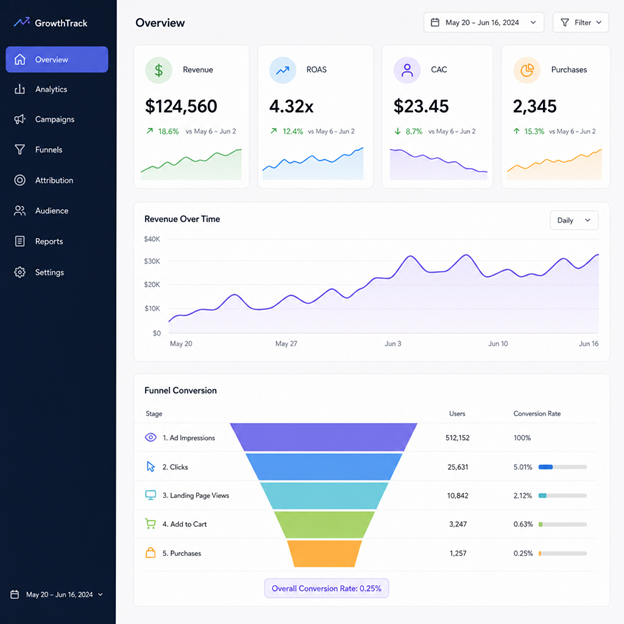
A performance dashboard tracking revenue, ROAS, CAC, and funnel conversion rates.
What “Performance” Means Now (and Why It’s Evolving Fast)
Performance used to mean direct response: clicks, leads, sales. It still does, but the way we measure it has changed:
- Privacy updates make simple, user-level tracking harder to rely on.
- Buyers take longer paths across more devices and channels before they convert.
- Creative quality now shapes performance as much as targeting or bid strategy does.
- Incrementality is replacing “last-click conversion” as the real measure of success.
A strong ecommerce digital marketing performance agency adapts by pairing solid media execution with analytics, structured experimentation, and conversion-first experiences. That combination is what genuine performance-driven marketing looks like in practice.
In other words, the future belongs to the performance agency that can still improve results even when tracking is imperfect, by fixing the funnel, sharpening the offer, and improving the creative, not just adjusting the bid.
What Does a Performance Marketer Do in 2026?
If you have ever wondered what a performance marketer actually does day to day, the answer goes well beyond “buys ads.”
A modern performance marketer typically owns or influences:
- Channel strategy: search, paid social, marketplaces, programmatic, affiliates
- Online performance marketing execution: budgeting, bidding, audience strategy
- Measurement: event tracking, offline conversion imports, attribution modelling
- Creative testing: angles, hooks, landing page messaging, offer framing
- CRO: page speed, UX, form optimisation, checkout improvements
- Unit economics: margins, LTV, payback periods, and CAC targets
- Experimentation: test design, holdouts, lift testing, geo tests
This is why many businesses now choose a digital growth agency or a digital strategy agency as their partner. The role has grown to blend media buying, analytics, and product-level thinking into one job.
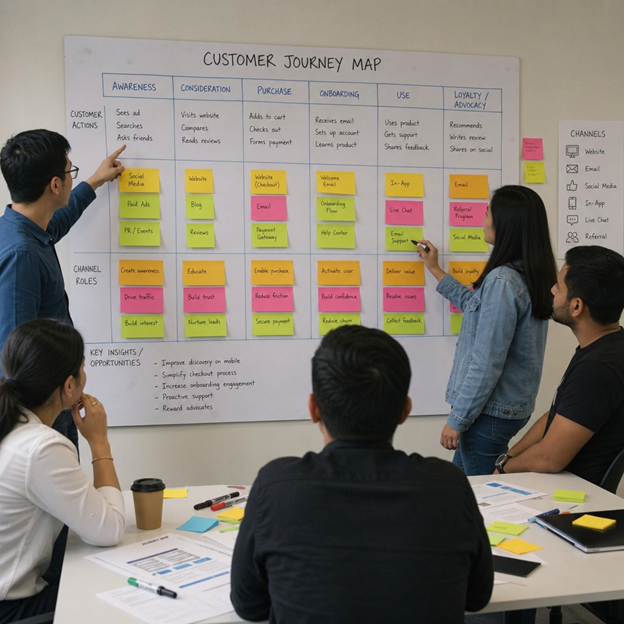
A growth team mapping the customer journey and channel roles during a workshop session.
The Digital Performance Marketing Agency vs Traditional Agencies
There are real alternatives to a traditional marketing agency, but not every “performance” shop actually operates like one. Here is the practical difference.
Traditional digital marketing agency (often)
- Broad services: social posts, branding, general website updates
- Vanity KPIs, such as followers or impressions, mixed in with genuine performance goals
- Less rigorous testing
- Reporting that explains results rather than improving them
Performance based digital marketing agency (best practice)
- Outcome-first planning built around pipeline, revenue, retention, and payback
- Tight cycles of test, learn, scale, and repeat
- A strong marketing optimisation mindset, treating the funnel and the creative as part of the job, not an afterthought
- A measurement approach built for today’s privacy constraints, not the tracking of five years ago
A genuine performance digital marketing agency will ask about your margins, conversion rates, sales cycle, and operational limits, because no amount of ad spend can outwork a broken funnel.
Channels Shaping the Future of Performance Marketing Services
The future is not about one channel winning. It is channel orchestration, where each channel plays a specific role inside the funnel. This broader approach is a key part of effective ecommerce marketing services, where multiple channels work together to attract customers, improve conversions, and support long-term growth.
1) Search: Beyond Keywords to Intent and Profit
Search stays foundational because it captures existing demand, and a strong ecommerce SEO strategy helps online stores attract qualified organic traffic from customers actively searching for relevant products. The real edge today comes from:
- Mapping keyword themes to the right funnel stage
- Using first-party data, such as CRM audiences and customer lists
- Profit-aware bidding, not just chasing a target CPA
Done well, Google Ads management delivers:
- Fast feedback on offers and messaging
- High-intent lead capture
- Scalable acquisition with cleaner measurement than most other channels
That is why PPC management for businesses remains a core service for any serious digital ad agency.
2) Paid Social: Creative Systems Beat “Targeting Hacks”
Paid social has shifted from micro-targeting toward macro creative iteration. A solid paid social campaign strategy focuses on:
- Creative volume paired with structured testing
- Clear offer tiers: entry, core, and premium
- Landing pages that match each creative angle
- Retargeting that adds real value, not just “come back” reminders
3) Onsite Conversion: The Hidden Growth Lever
If your ads are performing well but revenue is not moving, the bottleneck is usually onsite conversion, which is why conversion optimisation should be a core part of any performance marketing strategy.
That is where conversion rate optimisation tactics matter most:
- Cut page load time and remove friction
- Make the value proposition clear above the fold
- Add social proof near the call to action
- Simplify forms and improve error handling
- Use intent-matched landing pages for each ad set
4) Lifecycle and CRM: Performance Doesn’t End at the Click
More teams now measure performance across the full customer lifecycle, not just the first conversion:
- Email and SMS flows that lift lifetime value
- Faster lead-to-close speed
- Structured upsell and cross-sell sequencing
- Retention programs that ease pressure on CAC
Well-planned email marketing campaigns also play an important role in this process by nurturing customers, encouraging repeat purchases, and increasing lifetime value over time.
A capable online marketing services partner connects acquisition to lifecycle, because that is how you improve ROAS and CAC together. ROAS rises as lifetime value grows, and CAC becomes easier to justify once payback happens faster.
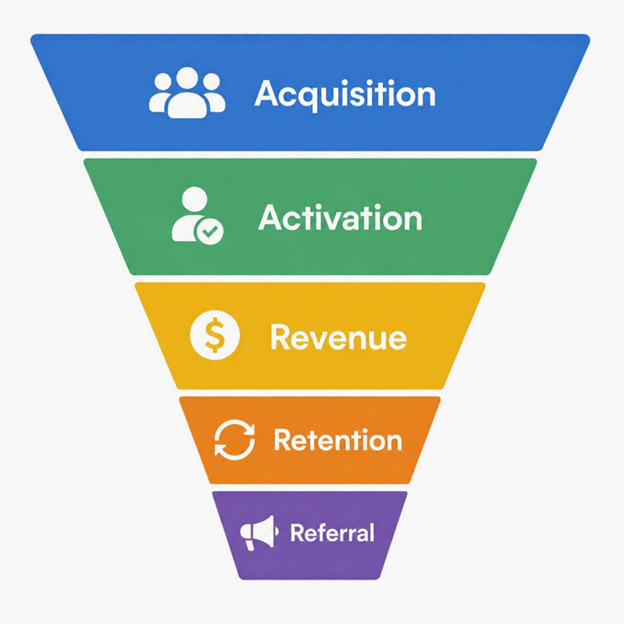
A five-stage growth funnel: acquisition, activation, revenue, retention, and referral.
The New Standard: Full-Funnel Measurement Without Overpromising
The future demands honesty: attribution is imperfect, and no agency should pretend otherwise. The best digital performance marketing agency teams use a blended measurement approach instead of relying on one number:
- Platform metrics: directional and fast
- Analytics events: consistent across the whole site
- CRM outcomes: qualified leads, opportunities, and revenue
- Media mix signals: how results respond to budget shifts
- Incrementality tests: holdout, geo, and lift testing where feasible
The goal is not perfect certainty. It is confident, well-informed decision-making.
Performance Marketing Pricing Models (and What’s Actually Fair)
Businesses often ask about performance marketing pricing models because they want incentives that stay aligned with their own. The honest answer is that no single model is “best.” It depends on your margins, sales cycle, and how reliable your data actually is.
Common pricing models for a pay for performance digital marketing agency relationship include:
- Flat retainer
Best for: stable spend plus ongoing CRO and creative systems
Pros: predictable costs, a deeper working partnership
Cons: some brands worry about “paying without guaranteed results,” which good KPIs can solve
- Percentage of ad spend
Best for: higher spend with fairly standardised execution
Pros: scales naturally with activity
Cons: can misalign incentives if success actually means spending less
- Hybrid (retainer plus performance bonus)
Best for: growth-stage companies that want shared alignment
Pros: shared upside, with a stable base that funds the team’s time
Cons: needs clean, agreed definitions of success
- Pure performance or revenue share
Best for: high-margin offers with reliable tracking
Pros: strong alignment between agency and client
Cons: can push short-term tactics unless proper guardrails are in place
A good performance marketing firm will recommend the model that fits your economics and measurement maturity, not simply the one that sounds most attractive on a pitch deck.
In-House Marketing vs Agency: The Real Decision Framework
The in-house marketing vs agency debate usually misses the point. The strongest setups are hybrid.
Choose in-house when:
- You already have strong internal creative and analytics talent
- You can hire channel experts and manage them well
- You need deep product context and fast internal approvals
Choose a digital performance marketing agency when:
- You need cross-channel expertise quickly
- You want proven systems for testing and scaling, not trial and error
- You need senior strategy without carrying senior payroll costs
- You want a partner who understands your specific vertical
A general digital marketing agency can be a good fit when your execution needs are broad. A performance marketing firm is usually the better choice when you are chasing aggressive revenue targets and need real accountability for the result.
How to Choose a Performance Agency (Checklist That Prevents Regret)
If you are searching for how to choose a performance agency, use this filter. It protects you from a polished pitch deck that hides weak fundamentals underneath.
Strategy and planning
- Do they ask about your margins, LTV, payback period, and capacity constraints?
- Can they explain the role each channel plays inside your funnel?
- Do they bring a clear testing roadmap for the first 30, 60, and 90 days?
Execution quality
- Do they show a real creative testing framework, not just “we test creative”?
- Can they explain their bidding and budget allocation approach in plain terms?
- Do they have genuine landing page and CRO capability, in-house or through partners?
Measurement maturity
- Can they connect performance to CRM stages and actual revenue?
- Do they have an incrementality plan ready if attribution gets noisy?
- Is their reporting transparent enough to include failures and learnings, not just wins?
Communication and accountability
- Who is actually working on your account day to day?
- How often do they ship new experiments?
- Which decisions get made weekly, and which are left for a monthly review?
Brand-specific fit matters here too. If you come across a social digital marketing agency performance marketing offer, treat it like any other vendor pitch: evaluate the team, the methodology, the reporting, and the proof of impact against your own goals. The name on the deck matters far less than the operating system behind it.
This applies just as much to Australian eCommerce brands weighing up local agencies in Sydney or Melbourne against larger national players. The market conditions differ, but the evaluation criteria do not.

A scoring sheet comparing four agencies across strategy, creative, measurement, and operations.
Best Performance Marketing Tools Powering the Next Wave
The best performance marketing tools are not just ad platforms. They form the stack that connects customer data, creative, and conversion into one working system.
A future-ready stack typically includes:
- Ad platforms: Google Ads, Microsoft Ads, Meta, TikTok, LinkedIn, as relevant to your audience
- Analytics: GA4 or an equivalent, with server-side tracking where it makes sense
- Tagging and consent: a consent management platform plus disciplined tag manager (GTM) setup
- Attribution and experimentation: lift tests, geo tests, and marketing mix modelling where feasible
- CRO: heatmaps, session recordings, A/B testing tools, and page speed monitoring
- CRM: HubSpot, Salesforce, or similar, with clean lifecycle stage definitions
- Data layer: a warehouse and dashboards that keep everyone working from the same KPI definitions
The goal is not owning every tool on the market. It is building a system where the whole team agrees on the same definitions for leads, revenue, and CAC.
The Performance Playbook: A Practical Marketing Funnel Optimisation Guide
Below is a streamlined, modern marketing funnel optimisation guide. It is the same playbook a collective creative digital performance marketing agency, or any high-functioning growth team, would follow.
Stage 1: Acquire (get the right click)
Goal: efficient traffic with clear intent.
Actions:
- Build a keyword and audience map organised by funnel stage
- Use message match, so the ad promise equals the landing page promise
- Create a creative testing plan that covers both volume and structure
Quick wins:
- Separate brand search from non-brand search
- Use dedicated landing pages for your top offers
- Add negative keywords and tighten intent on search campaigns
Stage 2: Convert (turn interest into action)
Goal: raise conversion rate without sacrificing lead quality.
Actions:
- Reduce friction with fewer form fields, clearer CTAs, and faster pages
- Add credibility through reviews, case studies, and certifications
- Match offers to intent, whether that is a demo, a trial, or a lead magnet
Quick wins:
- Keep your primary CTA visible above the fold
- Add FAQs near the point of conversion
- Improve mobile layout and page speed
Stage 3: Qualify (improve lead quality)
Goal: prevent wasted spend on leads that were never a fit.
Actions:
- Add qualifying questions, without overloading the form
- Route leads faster, using instant calendar booking and quicker follow-up
- Track lead quality back to the campaign and ad set that produced it
Quick wins:
- Create a “high-intent” path, such as booking a call, alongside a “low-intent” path like a download
- Use offline conversion imports wherever possible
Stage 4: Close (connect marketing to revenue)
Goal: increase close rate and shorten the sales cycle.
Actions:
- Track pipeline stages and conversion rates between them
- Build nurture sequences based on common objections
- Align marketing and sales on shared definitions for MQL and SQL
Quick wins:
- Improve speed-to-lead, often the single biggest lever available
- Add call scripts and objection-handling content for the sales team
Stage 5: Expand (make CAC easier by growing LTV)
Goal: increase retention and expand existing accounts.
Actions:
- Build onboarding and activation flows
- Promote upgrades and cross-sells at the right moment
- Create referral loops and loyalty incentives
Quick wins:
- Build “success milestone” email sequences
- Segment customers by use case or product adoption
This full-funnel view is what turns a marketing optimization agent into a genuine revenue multiplier, because it works on the whole system, not just the ads sitting at the top.
ROI-Driven Digital Advertising: What Winning Teams Do Differently
ROI-driven digital advertising requires a real mindset shift. You are not buying clicks. You are buying profitable growth.
Winning teams:
- Set CAC targets by product line, not just one blended average
- Treat creative as a genuine performance lever, not a branding afterthought
- Invest in landing page systems and ongoing CRO testing
- Tie every optimisation decision back to revenue outcomes, not just platform-reported KPIs
This is the core of online performance marketing and modern performance marketing services: a repeating loop of hypothesis, test, learning, and scale.
Lead Generation Campaign Optimisation: The B2B and High-Ticket Reality
For many businesses, especially in B2B, the “conversion” is not a purchase. It is a qualified lead. Lead generation campaign optimisation should focus on:
- Lead quality feedback loops coming directly from sales
- Pipeline conversion tracking from lead to meeting to SQL to closed-won
- Offer design that filters for fit, such as an assessment, an ROI calculator, or a workshop
Tactics that work well:
- Use multi-step forms to lift completion rates
- Build landing pages by industry or use case
- Run retargeting that answers real objections around pricing, timelines, and proof
A digital performance marketing agency that cannot connect spend to pipeline is not really a performance partner. It is a media vendor with a nicer name.
Improve ROAS and CAC: The Levers That Matter Most
To improve ROAS and CAC, focus on the levers with the biggest compounding effect over time:
- Offer: bundles, guarantees, pricing tests, positioning
- Creative: angles, proof points, differentiation, hooks
- Landing page: speed, clarity, social proof, friction removal
- Targeting: genuine intent and smart exclusions, not shortcuts or “hacks”
- Retention: onboarding, activation, and lifecycle marketing
The future of a performance marketing firm has less to do with outsmarting algorithms and more to do with building a genuinely better growth engine.
Where the Future Is Headed (and How to Prepare)
Here is what we are seeing across top-tier digital performance marketing agency roadmaps right now:
- Heavier emphasis on first-party data and CRM-connected optimisation
- Creative production systems that ship weekly, not quarterly
- More experiment design and incrementality testing, and fewer arguments about attribution
- Deeper integration of CRO and landing page work directly into paid media
- Better collaboration models that blend an external agency with an in-house growth pod
For Australian eCommerce businesses, this also means paying closer attention to first-party data as cookie-based tracking keeps getting less reliable, and building measurement that holds up regardless of which platform a customer arrives from.
This changes what you should expect from a performance agency too. It is not just reporting anymore. It is an operating rhythm built for continuous improvement.
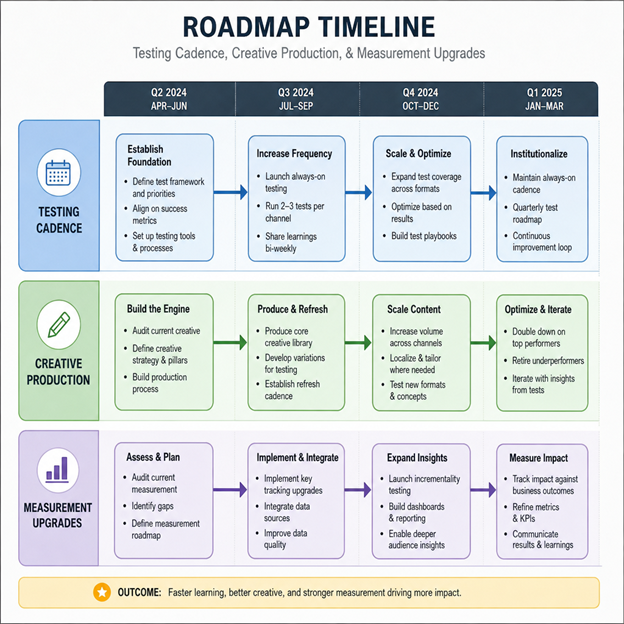
A roadmap timeline covering testing cadence, creative production, and measurement upgrades across four quarters.
Takeaway: The Future Belongs to Performance-Driven, System-Level Growth
The future of digital marketing is not “more ads.” It is smarter systems, where a digital performance marketing agency, or a performance based digital marketing agency, connects creative, media, and conversion into one continuous loop.
If you want predictable growth, choose a partner that can:
- Run PPC management for businesses and paid social at a genuinely high level
- Build a real experimentation roadmap, not just a media plan
- Execute conversion rate optimisation tactics that move the needle
- Prove impact through honest measurement
- Align every piece of work to profitability, not vanity metrics
That is the real difference between a basic digital ad agency and a true performance marketing firm built for what comes next. For Australian online businesses navigating rising ad costs and tighter margins, that difference is often what separates steady, sustainable growth from a channel that simply stops working.
Digital Performance Marketing Agency FAQs
Frequently Asked Questions
What makes a performance marketing agency different from a traditional digital agency?
A digital performance marketing agency focuses on clear business results. It tracks sales pipeline, revenue, and payback, and it works in fast test-and-learn loops that link creative, CRO, and media together.
A traditional digital marketing agency may offer a broader range of services, but it often reports on views or followers more than it reports on sales.
How do top performance marketers measure success when attribution isn’t perfect?
They combine several signals to make smart calls: fast platform data, consistent analytics events, CRM results tied to revenue, media mix and budget-shift signals, and lift tests such as holdouts and geo tests.
The goal is useful insight, not perfect maths.
Which channels matter most for future-ready performance marketing, and how should they work together?
No single channel wins on its own. Search captures high-intent demand and works well with smart bidding and first-party data in online performance marketing. Paid social depends on strong creative and clear, structured tests. Onsite conversion, or CRO, cuts friction and matches the page to intent. Lifecycle and CRM grow results after the click by improving lifetime value, speed-to-lead, upsells, and retention.
Used together, these channels raise ROAS and lower CAC.
What’s a practical way to optimise my funnel right now?
Follow the Acquire, Convert, Qualify, Close, Expand playbook. Match your ads to the landing page promise, run creative tests, and speed up your pages. Add proof and clear calls to action. Route and qualify leads faster, and connect campaigns directly to pipeline stages while you work on speed-to-lead.
Then build lifecycle programs that drive activation, upgrades, and referrals. Small gains at each step add up to meaningfully better ROAS and lower CAC.
How should I choose a performance agency and structure fees fairly?
A good performance marketing firm should fit your economics and your data quality. Use a checklist that reviews strategy depth, execution quality, measurement quality, and operating pace. Check your margins, LTV, and capacity. Review their creative systems, bidding approach, and CRO capability. Make sure CRM tie-out and lift testing are actually in place, and ask who does the work, how fast they ship, and how decisions get made.