You check your analytics dashboard. The numbers don’t look right.
Your organic traffic is dipping. Your best-performing blog posts the ones that brought in steady leads for years, are slowly fading. You haven’t changed your strategy. You are still publishing high-quality content. Your SEO agency is still sending you reports with green arrows and “keyword rankings.”
But the revenue isn’t following the report.
Something is blocking your growth. In the past, we called this an algorithm update. Today, it is something much bigger. It is a fundamental shift in how human beings find answers.
If you are a B2B eCommerce founder looking to fix this sales bottleneck, you are in the right place. We aren’t here to give you generic advice. We are here to show you exactly how to win AI search results in this new era.
The Silent Crisis: Where Did the Traffic Go?
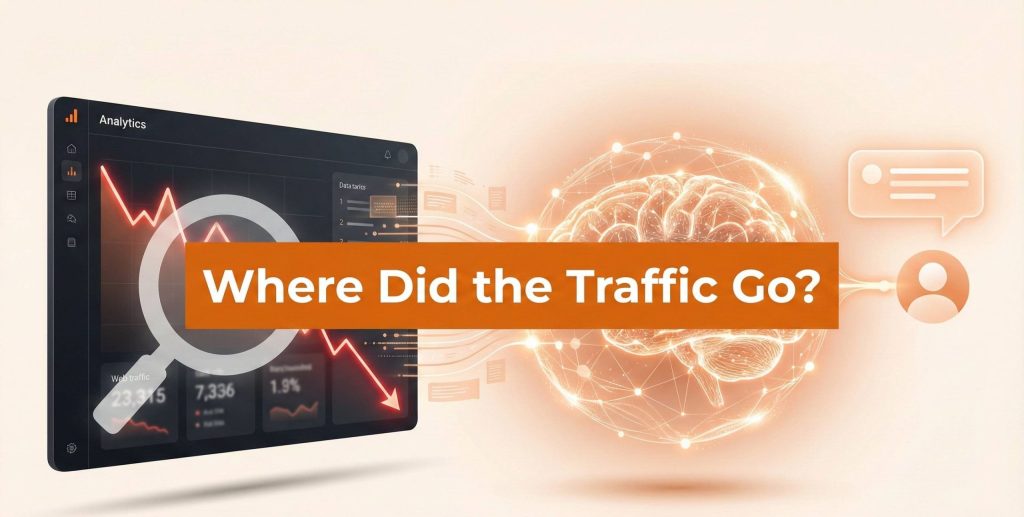
For two decades, the internet worked on a simple deal. You write an article, Google ranks it, and a user clicks the “blue link” to visit your website.
That deal is broken.
In 2026, users don’t want to hunt for links. They want answers. When a potential client asks, “What is the best logistics software for Australian B2B eCommerce?”, they aren’t typing that into a search bar to get a list of ten websites.
They are asking Perplexity, SearchGPT, or Gemini.
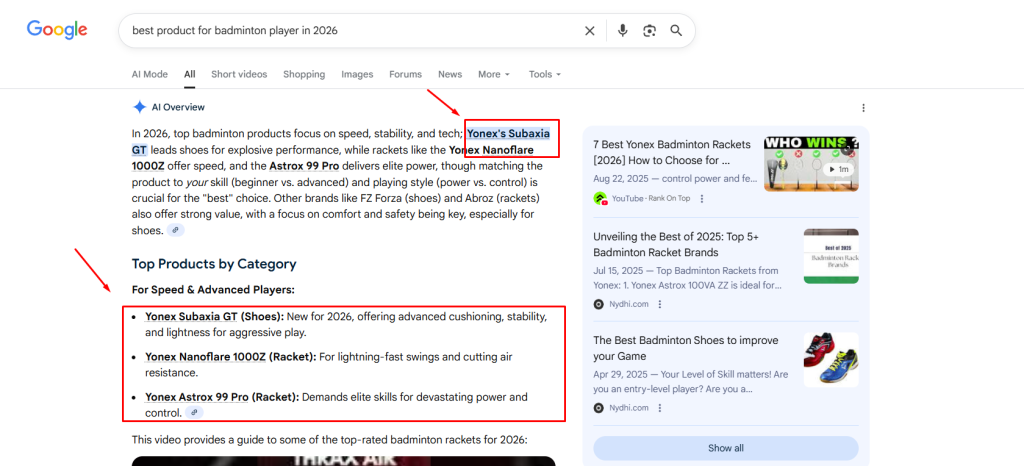
And guess what? The AI gives them the answer right there. It summarizes the top three options, compares prices, and gives a recommendation. The user gets the value without ever clicking on a website.
This is the Zero-Click reality.
If your brand isn’t the answer the AI recommends, you are invisible. You could be ranking #1 on traditional Google search, but if the AI doesn’t “trust” your data, you lose the customer before they even enter your sales funnel.
From SEO to GEO: The New Game
Traditional agencies will tell you to “buy more backlinks” or “write longer content.” That is the old way. It fixes yesterday’s problem.
To scale your B2B eCommerce growth now, you need to stop thinking about Search Engine Optimization (SEO). You need to start thinking about Generative Engine Optimization (GEO).
Here is the difference:
- SEO convinces a robot to rank your link.
- GEO convinces an AI model to cite your brand as the expert.
At CustomLiftBD, we see this pattern every day. We work with business owners who have great products but hit this invisible wall. They rely on vanity metrics likes, clicks, and old-school rankings while their competitors are quietly dominating the AI conversation.
The CustomLiftBD Stance: It’s Not Just Marketing, It’s Survival
We don’t view this as a technical issue. We view it as a business survival issue.
If an AI cannot “read” your business if it doesn’t know your pricing, your stock levels, or your unique value proposition it simply won’t recommend you. You are left fighting for the scraps of traffic that traditional search leaves behind.
But there is good news.
Most of your competitors are still asleep at the wheel. They are still stuffing keywords into blog posts. This creates a massive opportunity for you. By building a custom roadmap that focuses on data, trust, and authority, you can become the primary source of truth for these AI models.
We are going to show you how to break this barrier. We will move beyond the fluff and focus on the mechanics of AI search results in 2026.
Let’s fix this bottleneck together.
The Shift: SEO vs. GEO (Generative Engine Optimization)
Most business owners are playing a game that ended two years ago.
You are likely paying an agency to optimize your website for a “search engine spider.” This spider crawls your site, looks for keywords, counts your backlinks, and decides where to rank you on a list.
But in 2026, your customers aren’t just using search engines. They are using Thinking Engines.
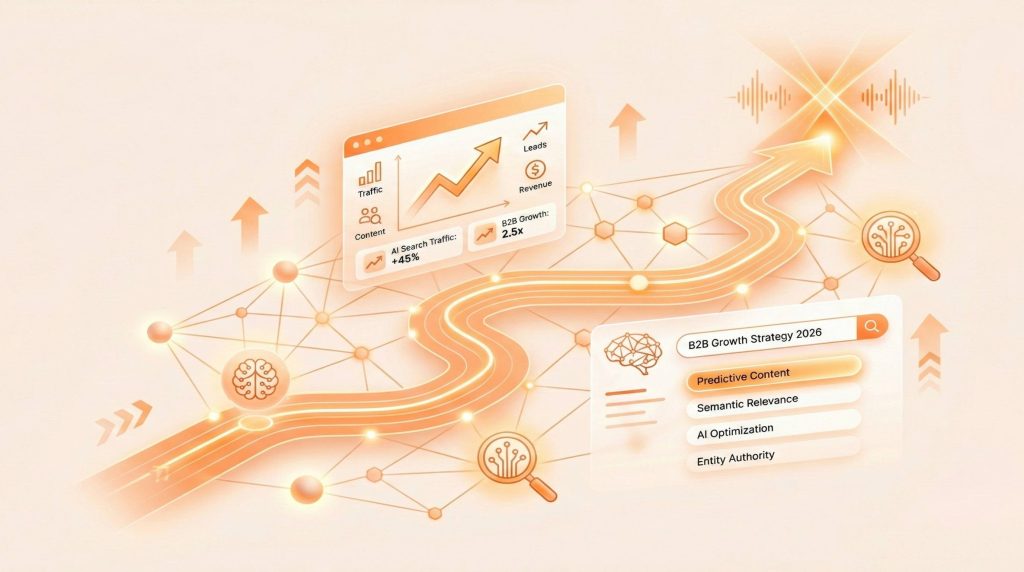
This is the massive technical shift that most agencies are hiding from you. When a user asks a question on SearchGPT or Google SGE (Search Generative Experience), the AI doesn’t just “look up” a website. It reads content, understands the context, and synthesizes a brand-new answer.
We call this Generative Engine Optimization (GEO).
The Old Way (SEO): The Directory Model
Think of traditional SEO like a library card catalog.
- Goal: Rank a URL (link) on Page 1.
- Strategy: Stuff keywords into headings and buy backlinks.
- Result: A list of blue links that forces the user to do the work.
- The Agency Lie: “We got you 1,000 impressions!” (But zero sales).
The New Way (GEO): The Expert Model
Think of GEO like a digital consultant.
- Goal: Win the citation (be the answer).
- Strategy: Provide Information Gain unique data, expert quotes, and proprietary facts.
- Result: A direct answer where the AI says, “According to CustomLiftBD, the best strategy is…”
- The Reality: You don’t need 1,000 clicks. You need to be the source of truth for the decision-maker.
Why Traditional Agencies Fail at GEO
This is where the “invisible barrier” we talked about earlier comes from.
Traditional marketing agencies are addicted to Vanity Metrics. They send you reports showing traffic spikes, but they don’t tell you that 80% of that traffic is bouncing because it’s not relevant. They focus on volume.
AI focuses on value.
Platforms like Perplexity and Gemini punish fluff. If your blog post is 2,000 words of generic advice that looks like everyone else’s, the AI ignores it. It treats your brand as “noise.” To win in 2026, you must stop writing for robots and start publishing High-Fact Density content that proves you are an authority.
We aren’t optimizing for a click anymore. We are optimizing for trust.
How AI “Reads” Your Business: Entities Over Keywords
Stop thinking about keywords.
For years, we taught computers to match strings of text. If you wanted to rank for “blue running shoes,” you put “blue running shoes” on your page five times. That was the era of keywords.
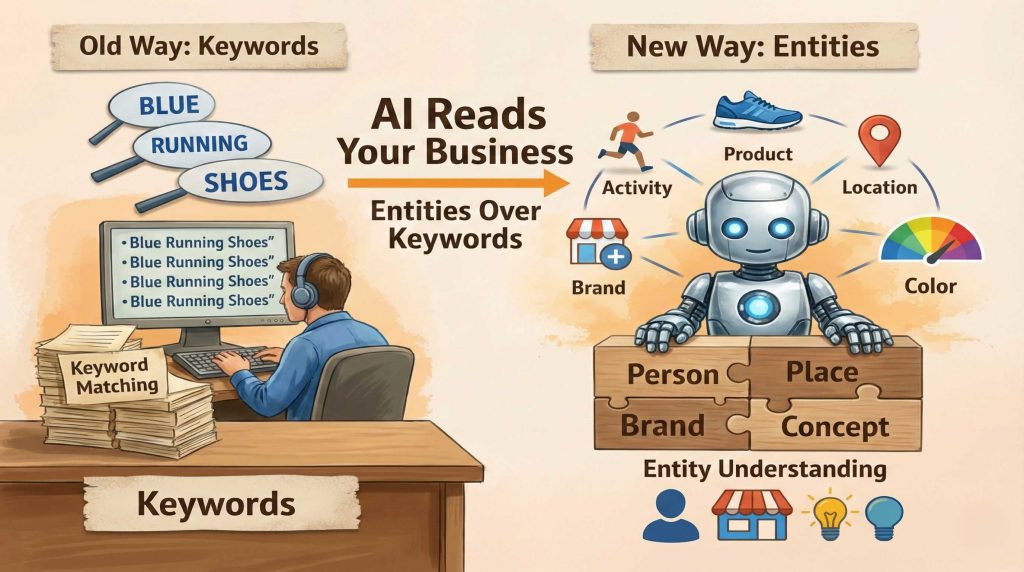
But AI Knowledge Graph Optimization has changed the rules. AI models like GPT-4 or Gemini do not read text like a scanner; they understand concepts like a human. They don’t look for “keywords”; they look for Entities.
What is an Entity?
An entity is a distinct “thing” a person, a place, a brand, or a concept.
- Keyword: “Apple” (Just a word).
- Entity: “Apple Inc.” (The technology company) OR “Apple” (The fruit).
The AI uses context to decide which entity you are talking about. It connects these entities in a massive web of data called a Knowledge Graph.
If your B2B eCommerce brand is just a collection of keywords to the AI, you are weak. You need to be a defined Entity. When an AI understands your brand as an entity, it knows who you are, what you sell, and why you matter without needing to guess.
The Trust Score: How AI Decides You Are “True”
Imagine you walk into a room of strangers. You say, “I am the best expert here.” No one believes you. But if three respected leaders point at you and say, “She is the expert,” everyone believes you.
This is exactly how Entity Authority works.
Perplexity and ChatGPT assign a hidden “confidence score” to your brand. They calculate this based on Brand Entity Signals.
- Consistency: Does your business name, address, and phone number match everywhere?
- Corroboration: Do other trusted entities (like industry news sites or partners) mention you?
- Depth: Does your content cover your topic fully, or is it surface-level?
If the AI finds conflicting information, for example, your LinkedIn says one thing and your website says another its confidence drops. When confidence drops, it stops showing you in the answer.
The “Vague Brand” Penalty
We see this sales bottleneck constantly at CustomLiftBD. A business owner asks, “Why aren’t we ranking?”
We look at their “About Us” page. It says: “We are a leading provider of high-quality solutions for customers worldwide.”
This is the “Vague Brand” Penalty. This sentence means nothing. It contains zero entities. “Leading provider” is not a specific fact. “High-quality solutions” is not a specific product.
To the AI, this website is empty noise.
LLM Optimization for eCommerce requires specificity. Instead of “solutions,” say “SaaS-based inventory management for Shopify.” Instead of “customers worldwide,” say “serving 500+ logistics firms in Australia and Canada.”
When you feed the AI specific facts, it can place your brand into the correct category in its brain.
Actionable Strategy: Define Your Digital Self
To win, you must force the AI to recognize you. You cannot wait for it to figure it out.
- Update Your “About” Page: Fill it with concrete nouns. List your founders, your specific location, your exact services, and your history.
- Use Semantic SEO: Don’t just write “best software.” Write about the concepts related to your software. If you sell coffee machines, you must also write about “bar pressure,” “grind size,” and “thermal stability.” This proves to the AI that you understand the entire topic.
- Get Verified: Ensure your profiles on Google Business, LinkedIn, and Crunchbase are identical. These are the “ID cards” the AI checks to verify you are real.
When you shift from chasing keywords to building Entity Authority, you stop fighting the algorithm and start partnering with it. You become a trusted source.
Content Strategy for 2026: Information Gain & Fact Density
For the last ten years, content marketing has been trapped in an echo chamber.
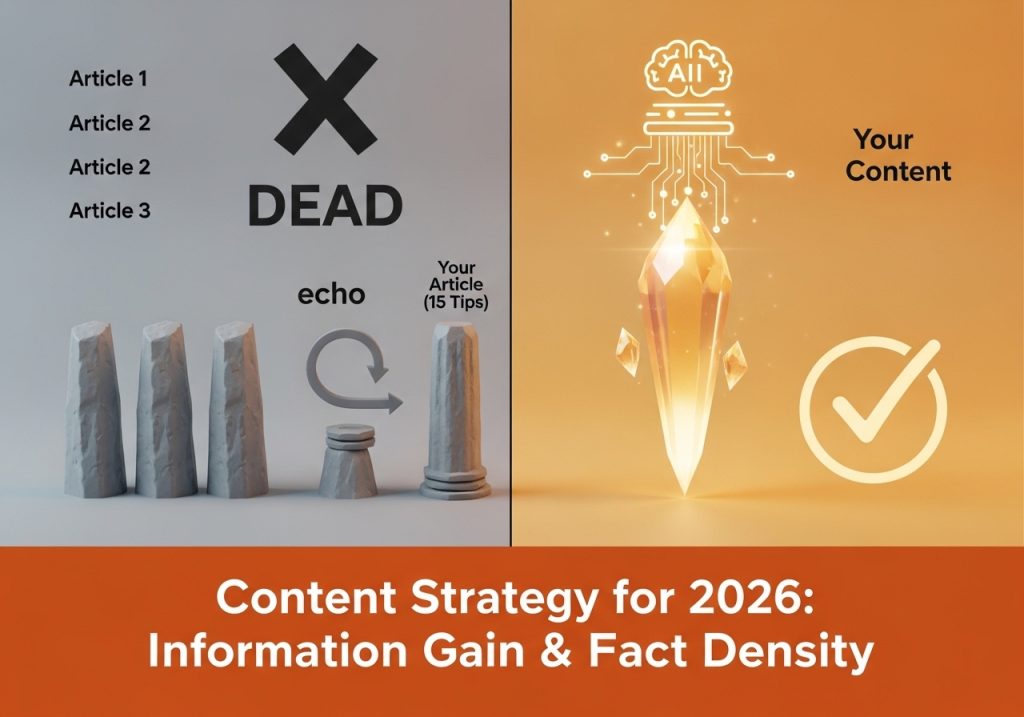
You probably know the “Skyscraper Technique.” The idea was simple: search for your keyword on Google, read the top three articles, and write a new one that is slightly longer. If they listed 10 tips, you listed 15.
This strategy is dead.
In 2026, Content for LLMs (Large Language Models) works differently. AI models have already read the entire internet. If you publish an article that just repeats what is already out there, the AI labels your content as “Redundant.” You offer no new value, so the AI has no reason to cite you.
To win, you must stop rewriting and start adding Information Gain.
What is Information Gain?
Information Gain is a score Google and AI models use to measure novelty. It asks a simple question: “Does this article add something new to the global database, or is it just a remix?”
If you want to rank, you must provide something that doesn’t exist elsewhere. This could be:
- Original data from your own customer base.
- A unique opinion that challenges industry norms.
- A personal story or case study that proves your experience.
If you aren’t adding to the conversation, you are invisible.
The Concept of “Fact Density”
At CustomLiftBD, we audit hundreds of blogs. The biggest problem we see is fluff.
Writers often use 500 words to say something that only takes 50 words. Humans might skim past this, but AI hates it. AI models crave data. They want Fact Density.
Fact Density is the ratio of distinct facts per paragraph.
- Low Density (Fluff): “Shipping costs are getting expensive these days. It is hard for business owners to manage their budgets when prices go up.” (0 Facts).
- High Density (Win): “In Q3 2025, Australian shipping costs rose by 14% due to fuel surcharges. Standard pallet rates for Melbourne to Sydney now average $180.” (3 Facts).
The AI will ignore the first sentence. It will memorize and cite the second sentence.
To master Zero-Click Search Strategy, you must respect the user’s time. Give them the hard data immediately. Do not bury the answer at the bottom of the page.
The Evolution of E-E-A-T
You have likely heard of E-E-A-T (Experience, Expertise, Authoritativeness, Trustworthiness). In the age of AI, this is no longer just a guideline; it is a filter.
AI can detect fake expertise. It knows if a generic writer researched a topic for 20 minutes or if a true expert wrote it.
- Experience: Use phrases like “In our testing…” or “We discovered…”
- Expertise: Use specific industry terminology correctly.
- Trustworthiness: Cite your sources and link to other high-authority data.
Expert Content requires a human touch. AI can write generic sentences, but it cannot replicate your specific life experience. Your unique perspective is your best defense against being replaced.
Case Study: The Tale of Two Logistics Firms
Let’s look at a hypothetical example to prove how this works in the B2B world. Two companies write an article about “Warehouse Automation.”
Company A (The Generic Approach): They hire a cheap writer. The article says, “Automation is great. It helps you save time and money. Robots are the future of warehousing.”
- Result: The AI reads this, sees nothing new, and ignores it.
Company B (The CustomLiftBD Approach): They interview their Head of Operations. The article says, “By implementing autonomous forklifts in our Brisbane facility, we reduced picking errors by 22% in the first month. However, maintenance costs increased by 5%.”
- Result: The AI sees unique data. When a user asks SearchGPT, “What are the downsides of warehouse automation?”, the AI cites Company B: “According to Company B, maintenance costs can rise by 5%.”
Company B wins the brand mention. Company A is forgotten.
To fix your sales bottlenecks, you must be like Company B. You must contribute real knowledge to the world, not just more noise.
Technical GEO: Speaking the Robot’s Language

You can write the best content in the world, but if the AI cannot read it, you lose.
Great content is like a gourmet meal. But without the right technical setup, it is like serving that meal in a locked room. Technical SEO for AI is the key that unlocks the door. It ensures that when a bot from Perplexity or Google Gemini visits your site, it understands exactly what it is looking at.
We don’t expect you to become a coder. But as a business owner, you must understand three critical technical pillars that are defining 2026.
Structured Data 2.0: Spoon-Feeding the AI
Imagine you hand a messy, handwritten menu to a waiter. They might misread the price or the ingredients. This is what a standard website looks like to an AI. It has to guess where your product price ends and your description begins.
Schema Markup for AI (or Structured Data) is like handing that waiter a digital spreadsheet. It is a standardized code that sits behind your website. It tells the AI explicitly:
- “This number is the price.”
- “This text is the SKU.”
- “This image is the product in blue.”
For B2B brands, eCommerce Product Schema is non-negotiable. If you sell industrial machinery, you need schema that lists the “weight,” “dimensions,” and “compatibility.” When a user asks SearchGPT, “What is the voltage of Model X?”, the AI pulls the answer directly from your schema.
If you don’t have this code, the AI might answer, “I don’t know.” That is a lost sale.
The Rise of llms.txt
For decades, we used a file called robots.txt to tell search engines which pages to crawl. In 2026, there is a new standard: llms.txt.
This is a specific file designed for Large Language Models. It acts like a VIP invitation list. It tells AI crawlers (like the ones powering ChatGPT or Claude) exactly where your most valuable content lives.
You can use this file to:
- Prioritize Content: Tell the AI, “Read our Case Studies first.”
- Block Noise: Tell the AI, “Ignore our legal disclaimer pages.”
- Clean Data: Provide a simplified version of your website stripped of ads and pop-ups, making it easier for the AI to process.
If your agency hasn’t set up an llms.txt file for your domain yet, they are behind the curve.
Context Windows and “The Inverted Pyramid”
AI models have a limit to how much text they can remember at once. We call this a “Context Window.”
If your article is 5,000 words long, but the answer to the customer’s question is buried in paragraph 45, the AI might miss it. It might “forget” the beginning of the article by the time it reaches the end.
To fix this, we use a journalism technique called the Inverted Pyramid.
- Top: The most important answer (The Who, What, Where, Why).
- Middle: Supporting details and data.
- Bottom: Background information.
By placing your key “Facts” and “Entities” at the very top of the page, you ensure they fit comfortably inside the AI’s immediate memory. You make it easy for the machine to find the truth.
The CustomLiftBD Technical Promise
This sounds complicated, right? It is.
Navigating Structured Data 2.0 and server protocols is difficult. That is why many businesses fail here. They try to install a plugin and hope for the best.
But hope is not a strategy. At CustomLiftBD, we handle the technical translation. We ensure your website speaks the robot’s language fluently, so you don’t have to worry about code, you just have to worry about handling the new leads.
The “Referral” Network: Winning Citations on SearchGPT & Perplexity

We have fixed your website. We have optimized your content. Now, we must look outside your walls.
In traditional SEO, the “backlink” was king. You wanted other websites to link to you. It was a vote of confidence.
But AI models don’t just count links. They read conversations.
If 50 real people on Reddit discuss your software and say, “It is the fastest option for small businesses,” the AI reads that. It learns that fact. When someone asks SearchGPT for the “fastest software,” your brand wins.
This is the new era of AI Citations. It is not about a blue link; it is about Brand Mentions in the places where AI learns its facts.
The New Backlink: Being in the Training Data
To win AI search results, you must insert your brand into the “Training Data.”
Training data is the massive library of text that AI models study. They trust high-authority sources more than random blogs.
We call this Digital PR for B2B. But this isn’t about boring press releases that no one reads. Instead, the goal is to get your brand mentioned where it counts:
- Niche Communities: Reddit, Quora, and specialized industry forums.
- News Outlets: Trusted business journals (e.g., Forbes, TechCrunch, or local Australian industry news).
- Review Platforms: Trustpilot, G2, and Capterra.
If the AI sees your name appear consistently across these trusted sites, it assigns you a high “Truth Score.”
Platform Specifics: Different Robots, Different Rules
Not all AI models think the same way. At CustomLiftBD, we tailor our strategy based on which platform your customers use most.
1. How to Optimize for Perplexity
Perplexity is the “Academic” of the group. It loves facts, footnotes, and hard data.
- What it wants: Reliable sources. It constantly cites where it found information.
- The Strategy: Publish white papers and original research reports. If you release a “2026 Logistics Report,” other sites will cite your data. Perplexity will see this and treat you as a primary source.
2. How to Optimize for SearchGPT
SearchGPT (by OpenAI) is the “Conversationalist.” It wants to give a direct, helpful answer in plain English.
- What it wants: Clarity and consensus. It looks for what the majority of people are saying.
- The Strategy: Focus on user reviews and clear, “How-To” content. If users on forums agree that your service solves a specific problem, SearchGPT picks up on that consensus.
3. How to Optimize for Gemini
Gemini is the “Google Insider.” It has a huge advantage: it can see everything in the Google ecosystem.
- What it wants: Multimedia signals. It looks at YouTube videos, Google Maps reviews, and Google Merchant Center data.
- The Strategy: Don’t just write text. Create YouTube videos explaining your product. Ensure your Google Business Profile is active. Gemini trusts Google’s own data more than anything else.
The “Surround Sound” Effect
This strategy creates a “Surround Sound” effect.
When a potential client searches for you, they don’t just see your website. They see your brand mentioned in forums, cited in news articles, and recommended in videos.
This convinces the AI and the human that you are the market leader.
You can’t buy this kind of authority. You have to build it. And that is exactly where most “cookie-cutter” agencies fail. They are still building links to your homepage while your competitors are building a reputation across the entire web.
Measuring Success: Beyond Vanity Metrics
You cannot deposit “impressions” into a bank account.

For years, agencies have handed business owners colorful PDF reports. They point to a graph and say, “Look! Your rankings went up!” But when you look at your sales figures, nothing has changed.
This is the trap of Vanity Metrics.
In the world of AI search, “Ranking #1” means less than it used to. Why? Because of the “Zero-Click” reality we discussed. If you rank #1, but the AI summarizes your content and gives the user the answer without mentioning your brand name, you have failed. You fed the robot, but you starved your business.
At CustomLiftBD, we don’t look at vanity metrics. We look at Real Revenue Growth. To do that in 2026, we have to change how we measure success.
The New Metric: Share of Model (SoM)
Forget “Share of Voice.” You need to measure Share of Model.
Share of Model (SoM) answers a specific question: When an AI answers a question about your industry, how often is your brand mentioned?
Imagine we ask Perplexity ten different questions about “B2B eCommerce logistics.”
- If your brand is mentioned in 6 out of 10 answers, your SoM is 60%.
- If you are mentioned 0 times, your SoM is 0% even if you rank #1 on Google.
Measuring AI Visibility is difficult because there is no single dashboard for it yet. It requires manual testing and smart analysis. But it is the only metric that correlates with future growth. If the AI is talking about you, the sales will follow. If you want the full formula for turning that visibility into a defensible revenue number, we’ve broken down the complete process in AI Visibility ROI: How to Measure and Calculate the Revenue Impact of AI Search
Tracking the “Invisible” Sale
Here is a scenario we see often:
- A CEO asks ChatGPT, “Who is the best supplier for X?”
- ChatGPT says, “CustomLiftBD is highly recommended for X.”
- The CEO closes ChatGPT.
- The CEO types “CustomLiftBD” directly into their browser.
Traditional analytics software (like Google Analytics) calls this “Direct Traffic.” It doesn’t know the lead came from AI. It looks like magic.
This leads to bad decisions. You might think your marketing isn’t working, so you cut the budget. In reality, your Zero-Click strategy is driving everything.
We help clients look for Branded Search Spikes. If your overall traffic is flat, but more people are searching for your specific company name, that is proof that your Results Over Vanity Metrics approach is winning.
Your Custom Growth Roadmap
The internet has changed. The way your customers buy has changed. The question is: Have you?
We are standing at the biggest shift in digital marketing since the invention of Google. The era of keywords, blue links, and generic content is ending. The era of Generative Engine Optimization of facts, entities, and trust is here.
This might feel overwhelming. You have a business to run. You don’t have time to learn about Knowledge Graphs, llms.txt files, or vector embeddings.
That is why CustomLiftBD exists.
We are not here to sell you a package of blog posts. Instead, we act as your dedicated partner. Our entire mission is to find the Sales Bottlenecks that are choking your growth and fix them with surgical precision.
The Choice is Yours
You have two options today:
- The Old Path: Keep hiring traditional agencies. Keep chasing vanity metrics. Watch as your traffic slowly bleeds away to competitors who adapted faster.
- The Growth Path: Accept that AI is the new gatekeeper. Build a strategy that speaks its language. Become the undeniable authority in your market.
If you are ready to stop guessing and start scaling, we are ready to help.
Is your business invisible to AI? Let’s audit your digital footprint and build a Custom Growth Plan that drives revenue, not just reports.