Introduction
AI search is changing how people discover information online. Instead of clicking through ten blue links, users now ask complete questions and receive direct answers from tools like ChatGPT, Claude, Gemini, Perplexity, and Google’s AI-powered search experience.
That shift has created a new challenge for marketers, SEO professionals, content creators, and business owners. Ranking on a traditional search results page is still important, but it is no longer the only goal. Today, your content also needs to be understood, trusted, and surfaced by AI systems. This is where AI Search Optimization becomes essential.
Unlike traditional SEO, AI Search Optimization focuses on helping AI models understand your expertise, recognize your entities, connect your content with relevant topics, and confidently reference your website when answering users’ questions. It combines technical SEO, semantic SEO, content quality, entity optimization, and user intent into a single strategy.
The good news is that you do not need expensive software to start improving your AI search visibility. With the right prompts, ChatGPT and Claude can help you research topics, uncover search intent, strengthen topical authority, improve semantic relevance, optimize product pages, create better content briefs, and identify opportunities that many competitors miss.
This guide brings together practical ChatGPT and Claude prompts designed to support every stage of AI Search Optimization. Whether you manage an eCommerce store, publish blog content, work in SEO, or lead a marketing team, these prompts will help you build content that is clearer, more helpful, and more likely to appear across modern AI search experiences.
Throughout this guide, you will also learn when to use each prompt, why it works, and how to get better results instead of simply copying and pasting instructions into an AI tool.
What Is AI Search Optimization?
AI Search Optimization is the process of improving your website, content, and digital presence so AI-powered search systems can understand, evaluate, and recommend your information more effectively.
Traditional SEO mainly focuses on improving rankings in search engine results pages. AI Search Optimization goes one step further. It aims to make your content easier for AI systems to interpret, summarize, compare, and cite when answering user questions.
For example, imagine someone asks:
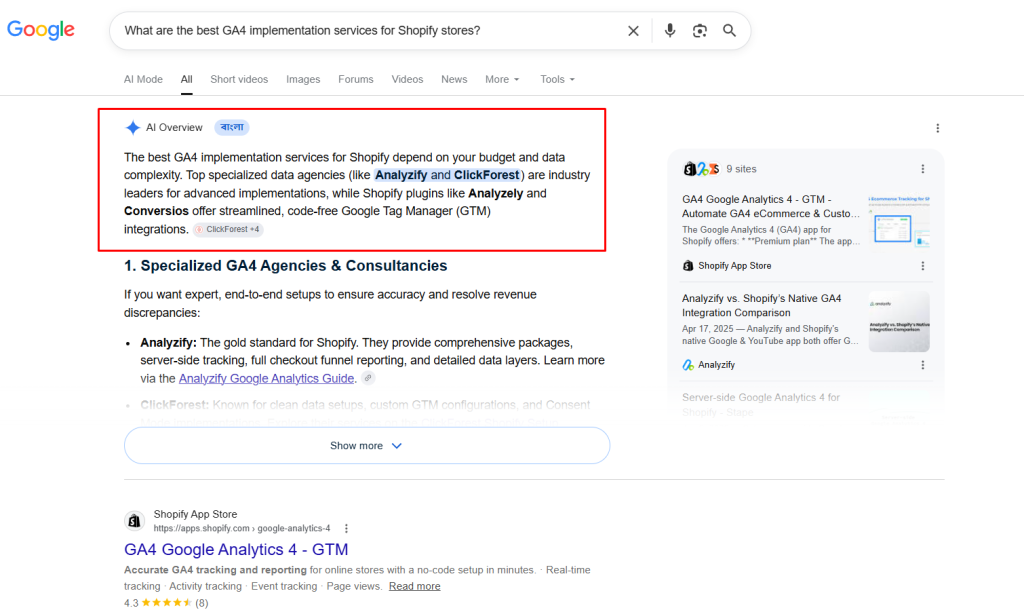
“What are the best GA4 implementation services for Shopify stores?”
An AI assistant may generate an answer by combining information from multiple trusted sources instead of displaying only a list of links. If your content clearly explains the topic, demonstrates expertise, answers related questions, and provides useful context, it has a better chance of being referenced in that answer.
This does not happen because of a single ranking trick. It happens because AI systems can confidently understand what your content covers and why it is useful.
Successful AI Search Optimization usually combines several disciplines, including:
- High-quality, original content
- Semantic SEO
- Entity optimization
- Strong internal linking
- Clear website structure
- Helpful examples
- Topic clusters
- Schema markup where appropriate
- Content that satisfies user intent
These elements work together to improve AI Search Visibility across different AI-powered platforms.
How AI Search Differs from Traditional SEO
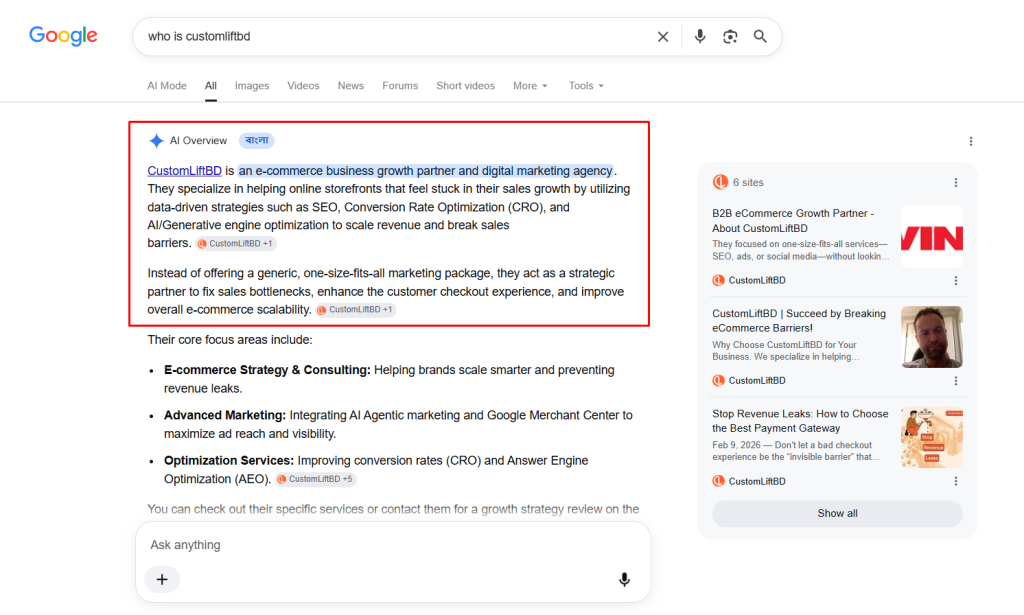
Traditional SEO asks:
“How can this page rank higher?”
AI Search Optimization asks:
“Can an AI system understand, trust, and confidently recommend this page?”
That difference changes how content should be created.
Instead of writing only for keywords, modern content should answer real questions, explain concepts clearly, connect related ideas, and demonstrate expertise through practical examples.
This is one reason semantic SEO has become more valuable than repeating the same keyword throughout an article.
AI Search Optimization Is Not Just About Google
Many people think AI optimization only means appearing in Google’s AI Overview.
In reality, users now search across multiple AI platforms, including ChatGPT, Claude, Gemini, Perplexity, and other AI-powered assistants. Each system evaluates content differently, but they all reward information that is accurate, well-structured, easy to understand, and genuinely useful.
Rather than optimizing for one platform, build content that serves people first. When your content is comprehensive, trustworthy, and well organized, it becomes easier for different AI systems to interpret and reference.
Why AI Search Optimization Matters in 2026
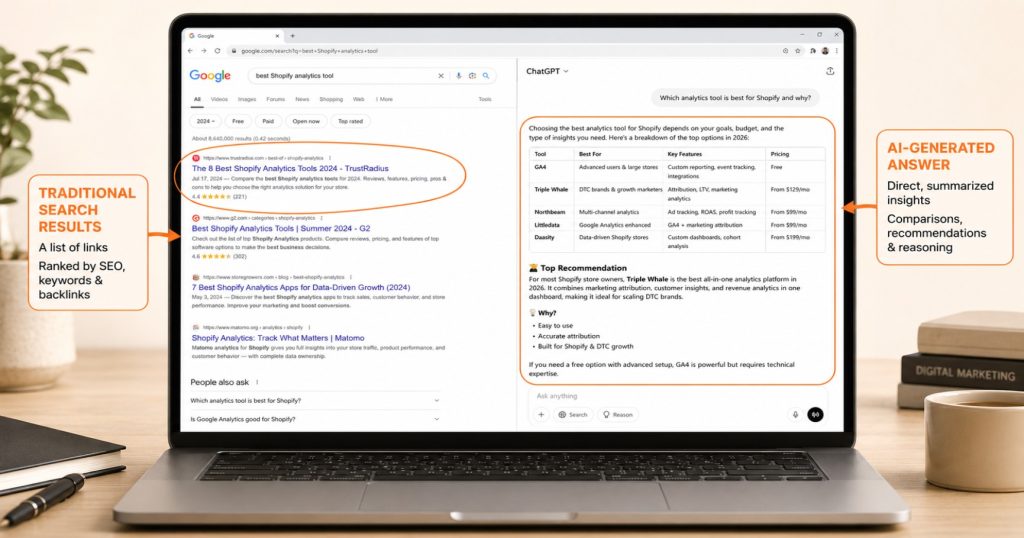
Search behavior has changed significantly over the past few years.
People increasingly ask complete questions instead of typing short keywords. They expect direct answers, comparisons, recommendations, and step-by-step guidance. AI-powered search experiences are designed to provide those answers immediately.
This shift means visibility is no longer measured only by rankings. Your brand can also gain exposure when AI systems mention your products, services, research, or expertise while responding to user questions.
For businesses, this creates both opportunities and challenges.
Companies that continue publishing generic, keyword-focused content may find it harder to stand out. Meanwhile, businesses that invest in topical authority, semantic relationships, original insights, and AI Search Optimization are more likely to become trusted sources.
If your goal is to understand the broader strategy behind AI-powered discovery, our guide on How to Win AI Search Results in 2026 explains the ranking signals, content strategies, and optimization techniques that help businesses improve visibility across modern AI search experiences. And once that visibility is in place, our guide to AI Visibility ROI shows you how to prove what it’s actually worth.
For eCommerce brands, this change is especially important.
Potential customers now ask AI assistants questions like:
- Which analytics tool is best for Shopify?
- How do I improve GA4 tracking accuracy?
- What is the best CRO strategy for an online store?
- Which SEO agency specializes in eCommerce growth?
These questions often receive AI-generated answers before users visit any website.
If your content helps answer these questions clearly, your business has more opportunities to earn visibility, trust, and qualified traffic.
For example, a detailed guide on product page optimization that includes original examples, structured explanations, and practical recommendations is generally more valuable than a short article filled with repeated keywords.
This is why many marketers are expanding beyond traditional SEO and investing in AI Search Visibility, entity-based optimization, and content designed for modern search experiences.
Before You Use AI Prompts: Principles That Actually Matter
Many people believe the secret to better AI-generated content is finding the perfect prompt.
It is not.
A prompt is only one part of the process. The quality of the information you provide is just as important as the prompt itself.
Before asking ChatGPT or Claude to help with AI Search Optimization, keep these principles in mind.
Start With Clear Context
Never begin with a vague instruction like:
“Write an SEO article.”
Instead, explain your audience, business, industry, goals, and desired outcome.
The more useful context you provide, the more relevant the response will be.
Define Your Target Audience
Content written for beginners should not sound the same as content written for experienced SEO professionals.
Tell the AI exactly who you are writing for.
For example:
- eCommerce founders
- Marketing managers
- SEO specialists
- Content marketers
- Small business owners
This helps the AI adjust its explanations, examples, and vocabulary.
Focus on Search Intent, Not Just Keywords
A keyword tells you what people search for.
Search intent explains why they search.
If someone searches for “AI Search Optimization prompts,” they are usually looking for practical prompts they can use immediately not a long theoretical discussion.
Meeting that intent is more important than repeating the keyword multiple times.
Add Constraints to Improve Quality
Good prompts include clear instructions.
For example:
- Use simple English.
- Write in active voice.
- Include practical examples.
- Avoid unnecessary jargon.
- Explain each recommendation clearly.
- Organize the response with H2 and H3 headings.
These constraints help produce content that is easier to read and easier to improve.
Always Review AI Output
AI should support your workflow, not replace your judgment.
Before publishing any content, review every section carefully.
Add your own expertise, include real examples, verify factual claims, and remove anything that sounds generic or repetitive.
This final review is often what transforms an average AI-assisted draft into a high-quality resource that readers trust.
ChatGPT vs Claude for AI Search Optimization
Before using prompts, it helps to understand the strengths of each platform.
Both ChatGPT and Claude can support AI Search Optimization, but they often excel in different areas.
| Task | ChatGPT | Claude |
| Keyword Research | Excellent | Very Good |
| Content Planning | Excellent | Excellent |
| Search Intent Analysis | Excellent | Excellent |
| Semantic SEO | Very Good | Excellent |
| Long-Form Content Review | Very Good | Excellent |
| Content Refinement | Very Good | Excellent |
| Structured Outputs | Excellent | Very Good |
| Topical Authority Mapping | Very Good | Excellent |
There is no universal winner.
Many marketers use ChatGPT for brainstorming, keyword discovery, and content planning. They often use Claude for deeper analysis, content refinement, semantic relationships, and identifying missing context.
For the best results, treat both tools as assistants rather than content creators. Their real value comes from helping you think faster, identify opportunities, and improve content quality.
As AI becomes more capable, many businesses are moving beyond individual prompts and building automated marketing workflows powered by AI agents. If you want to learn how these systems support eCommerce growth, read our guide on AI Agentic Marketing for eCommerce: A Practical Guide to Smarter Growth.
ChatGPT Prompts for Keyword Research
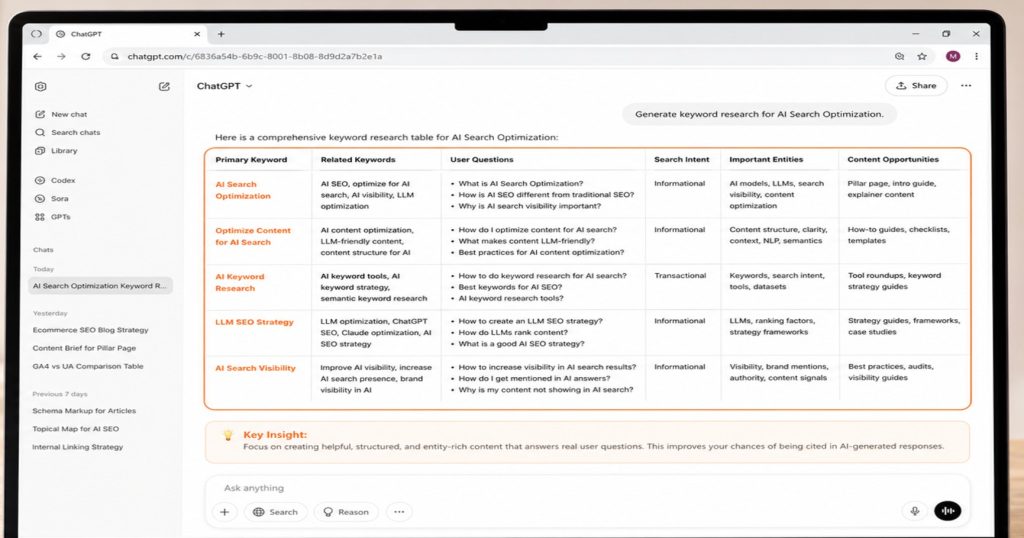
Keyword research remains one of the most important parts of AI Search Optimization.
However, modern keyword research goes beyond search volume. You also need to understand user questions, topical relationships, entities, and content opportunities.
Prompt 1: Find Primary Keywords
Goal
Discover high-level keyword opportunities around a topic.
Prompt
Act as an SEO strategist.
My business is [business type].
My target audience is [audience].
Generate 25 primary keywords related to [topic].
Group them by search intent and business relevance.
Present the results in a table.
Why It Works
Instead of producing random keyword ideas, this prompt forces the AI to think strategically and organize opportunities around actual business goals.
Best Use Cases
- New websites
- Topic planning
- Service page planning
- Blog strategy
Pro Tip
Always provide your audience and industry.
The quality of the output improves significantly.
Prompt 2: Find Long-Tail Keywords
Goal
Identify easier opportunities with stronger intent.
Prompt
Generate 50 long-tail keyword ideas related to [topic].
Include:
– Search intent
– Difficulty estimate
– Content type recommendation
– Funnel stage
Prioritize keywords with commercial or transactional intent.
Why It Works
Long-tail keywords often align better with how people interact with AI search systems.
Many AI-powered searches are naturally conversational.
Prompt 3: Discover Question-Based Keywords
Goal
Find questions users ask AI assistants.
Prompt
List 50 real-world questions users may ask about [topic].
Group them by:
– Beginner
– Intermediate
– Advanced
Include questions likely to appear in AI-powered search environments.
Expected Outcome
A strong list of FAQ opportunities.
These questions can later support:
- AI Overview Optimization
- FAQ sections
- Featured snippets
- AI Search Visibility
Prompt 4: Find Buyer Intent Keywords
Goal
Identify keywords that indicate purchasing intent.
Prompt
Generate 30 buyer-intent keywords related to [product or service].
Classify each keyword as:
– Commercial Investigation
– Transactional
– Comparison
– Decision Stage
Explain why users search each keyword.
Why It Works
Not every keyword drives revenue.
This prompt helps identify terms that may lead to conversions.
ChatGPT Prompts for Search Intent Analysis
Many content failures happen because marketers target the right keyword but the wrong intent.
AI systems care deeply about intent matching.
If your content does not satisfy user intent, visibility becomes much harder to earn.
Prompt 5: Analyze Search Intent
Goal
Understand why users search a keyword.
Prompt
Analyze the search intent behind the keyword:
[Keyword]
Explain:
– Primary intent
– Secondary intent
– User goals
– Questions users want answered
– Recommended content format
Why It Works
It helps you align content with user expectations.
Prompt 6: Identify Missing User Questions
Goal
Uncover questions competitors may overlook.
Prompt
For the topic:
[Topic]
List 50 important questions users may have before, during, and after searching this topic.
Organize the questions by user journey stage.
Best Use Cases
- Blog content
- Service pages
- Product pages
- Knowledge hubs
Prompt 7: Predict Follow-Up Searches
Goal
Build content depth.
Prompt
A user searches:
[Keyword]
Predict the next 20 questions they are likely to ask.
Arrange them in logical order.
Why It Works
AI Search Optimization rewards comprehensive content.
Answering follow-up questions improves topical coverage and user satisfaction.
ChatGPT Prompts for Content Planning
Strong content starts with planning.
Many businesses publish random articles and hope for results.
Instead, build content around a structured strategy.
Prompt 8: Create a Topic Cluster
Goal
Build topical authority.
Prompt
Create a complete topic cluster around:
[Main Topic]
Include:
– Pillar page
– Supporting articles
– FAQ content
– Comparison content
– Commercial content
Explain how each piece connects.
Why It Works
Topic clusters help search engines and AI systems understand expertise.
They also create excellent internal linking opportunities.
For example, CustomLiftBD could build topic clusters around:
- AI Search Optimization
- GA4 Tracking
- Conversion Tracking
- eCommerce SEO
- AI Visibility
Prompt 9: Generate an SEO Content Calendar
Goal
Plan content consistently.
Prompt
Create a 90-day SEO content calendar for:
[Industry]
Include:
– Article title
– Primary keyword
– Search intent
– Funnel stage
– Publishing priority
Expected Outcome
A structured roadmap instead of random content creation.
Prompt 10: Build a Detailed Article Outline
Goal
Create better content structures.
Prompt
Create a detailed SEO article outline for:
[Keyword]
Requirements:
– H1
– H2
– H3
– FAQ section
– Internal linking suggestions
– Related entities
– Semantic keywords
The outline should satisfy user intent completely.
Why It Works
A strong outline often determines the success of the final article.
ChatGPT Prompts for AI Content Optimization
Publishing content is only the beginning.
Optimization often creates the biggest improvements.
Prompt 11: Improve Topical Depth
Goal
Identify missing information.
Prompt
Review the article below.
Identify:
Opportunities to add relevant statistics or supporting data
Subtopics that need more coverage
Important entities that should be included
Practical examples that would strengthen the content
User questions that remain unanswered
Recommend improvements that increase topical depth.
Why It Works
AI systems tend to prefer content that covers a topic thoroughly.
Prompt 12: Improve Readability
Goal
Make content easier to consume.
Prompt
Review this article.
Improve:
– Clarity
– Flow
– Readability
– Active voice
– Sentence structure
Keep the original meaning unchanged.
Best Use Cases
- Blog posts
- Landing pages
- Product descriptions
- Service pages
Prompt 13: Optimize for AI Search Visibility
Goal
Make content easier for AI systems to understand.
Prompt
Analyze the article below.
Suggest improvements for:
– AI Search Optimization
– AI Search Visibility
– Entity coverage
– Semantic relevance
– User intent satisfaction
– Content structure
Explain why each recommendation matters.
Why It Works
This prompt focuses on the signals that help AI systems interpret content more effectively.
Prompt 14: Strengthen EEAT Signals
Goal
Improve trust and authority.
Prompt
Review this content and identify opportunities to improve:
– Experience
– Expertise
– Authoritativeness
– Trustworthiness
Provide actionable recommendations.
Expected Outcome
More credibility and stronger trust signals.
Prompt 15: Find Weak Sections
Goal
Improve overall content quality.
Prompt
Act as a content editor.
Review this article.
Identify:
– Weak sections
– Repetitive sections
– Thin sections
– Confusing sections
Suggest specific improvements.
Pro Tip
Run this prompt before publishing every important article.
Small improvements often create better engagement and retention.
Semantic SEO Prompts
Semantic SEO is no longer optional. AI search systems do not simply count keywords. They analyze relationships between concepts, entities, topics, and user intent.
Instead of asking, “Does this page mention the keyword enough times?” modern AI systems ask, “Does this page completely explain the topic?”
That is why semantic optimization has become a core part of AI Search Optimization.
Prompt 16: Expand Semantic Coverage
Goal
Identify related concepts that strengthen topical relevance.
Prompt
Act as a Semantic SEO expert.
Analyze my article about:
[Topic]
Identify:
– Missing semantic keywords
– Related concepts
– Supporting topics
– Contextual phrases
– Industry terminology
Explain where each suggestion should be added naturally.
Why It Works
Rather than repeating the same keyword, this prompt helps expand topical depth using closely related concepts.
Best Use Cases
- Pillar pages
- Service pages
- Long-form blog posts
Pro Tip
Do not force every suggested phrase into the article. Add only the concepts that genuinely improve understanding.
Prompt 17: Discover Topic Relationships
Goal
Understand how your main topic connects to related subjects.
Prompt
Create a semantic relationship map for:
[Topic]
Include:
– Parent topics
– Child topics
– Related entities
– Supporting concepts
– Frequently associated questions
Present the information in a logical hierarchy.
Why It Works
This prompt helps build stronger topic clusters and improves content planning.
Entity SEO Prompts
Search engines and AI models increasingly rely on entities rather than isolated keywords.
An entity can be a company, product, person, technology, location, event, or concept with a clear identity.
For example:
- GA4
- Shopify
- Google Merchant Center
- OpenAI
- CustomLiftBD
When AI understands the entities within your content and how they relate to one another, it gains more confidence in interpreting your page.
Prompt 18: Find Missing Entities
Goal
Improve entity coverage.
Prompt
Review my article about:
[Topic]
Identify important entities that should be included.
For each entity explain:
– Why it matters
– Where it fits naturally
– How it supports AI Search Optimization
Best Use Cases
- Educational content
- SaaS content
- eCommerce SEO
- Technical articles
Prompt 19: Build an Entity Map
Goal
Understand relationships between important entities.
Prompt
Create an entity map for:
[Topic]
Connect:
– Brands
– Products
– Technologies
– Organizations
– Industry concepts
Explain how each entity relates to the others.
Why It Works
Entity mapping makes it easier to create comprehensive content that reflects how AI systems connect information.
EEAT Improvement Prompts
Experience, Expertise, Authoritativeness, and Trustworthiness (EEAT) remain essential for creating content that users and search systems can trust.
AI cannot invent genuine experience. However, it can help identify areas where your article needs stronger evidence, examples, or expert insights.
Prompt 20: Strengthen EEAT Signals
Goal
Improve credibility.
Prompt
Review my article.
Identify opportunities to improve:
– Experience
– Expertise
– Authority
– Trust
Recommend practical improvements without changing the original message.
Why It Works
Readers trust content that includes practical examples, accurate explanations, and clear evidence.
Pro Tip
Whenever possible, replace generic statements with your own experience, case studies, screenshots, or original data.
Those additions are difficult to replicate and significantly improve content quality.
Prompt 21: Find Weak Trust Signals
Goal
Identify areas that reduce credibility.
Prompt
Act as an experienced editor.
Review this article.
Identify sections that seem:
– Generic
– Unsupported
– Overly promotional
– Unclear
Suggest specific improvements.
Expected Outcome
A stronger article with more convincing explanations and clearer evidence.
AI Overview Optimization Prompts
Many users now receive answers directly from Google’s AI-powered search experience before clicking on a website.
Although no prompt can guarantee inclusion in AI-generated answers, these prompts help create content that is easier to summarize, interpret, and reference.
AI Overview Optimization is closely related to Answer Engine Optimization (AEO). If you want to learn how answer-focused content increases visibility in AI-generated responses, explore our complete guide to Answer Engine Optimization and its role in the future of search.
Prompt 22: Optimize for AI Overview
Goal
Improve answer quality.
Prompt
Review this article.
Suggest improvements that make the content easier for AI systems to summarize.
Focus on:
– Clear explanations
– Direct answers
– Concise definitions
– Helpful examples
– Logical structure
Why It Works
AI-generated answers often rely on content that is well organized and easy to interpret.
Prompt 23: Improve Answer Sections
Goal
Create stronger question-and-answer content.
Prompt
Identify questions users are likely to ask about:
[Topic]
Write concise answers that are accurate, practical, and easy to understand.
Limit each answer to approximately 100 words.
Best Use Cases
- FAQ sections
- Knowledge bases
- Educational content
AI Search Visibility Prompts
Improving visibility in AI search requires more than ranking for keywords.
Your content should answer real questions, cover related topics, and demonstrate expertise.
Prompt 24: Evaluate AI Search Visibility
Goal
Find opportunities to improve discoverability.
Prompt
Review my article.
Evaluate its potential for AI Search Visibility.
Analyze:
– Topic coverage
– Entity coverage
– Search intent
– Content depth
– Readability
– Content structure
Recommend improvements.
Why It Works
This prompt reviews multiple quality signals instead of focusing on a single SEO metric.
Prompt 25: Improve AI Readability
Goal
Make content easier for AI systems and readers to understand.
Prompt
Rewrite sections that are:
– Too complex
– Too long
– Repetitive
– Difficult to scan
Maintain the original meaning while improving clarity.
Pro Tip
Clear writing benefits both human readers and AI systems. Simplicity often improves understanding without reducing authority.
Product Page Optimization Prompts
Product pages are often overlooked in AI Search Optimization.
Many pages contain only a short description and a list of features.
AI search systems, however, understand products better when pages explain benefits, use cases, comparisons, and frequently asked questions.
Prompt 26: Improve Product Page Content
Goal
Create more informative product pages.
Prompt
Review this product page.
Suggest improvements for:
– Product description
– Benefits
– Features
– FAQs
– User concerns
– Comparison opportunities
– AI Search Optimization
Why It Works
Comprehensive product pages provide richer context, making them more useful for both users and AI systems.
Prompt 27: Generate Product FAQs
Goal
Address common customer questions.
Prompt
Generate 25 FAQs for:
[Product]
Answer each question clearly using simple English.
Focus on helping potential customers make informed decisions.
Expected Outcome
A stronger product page with better coverage of user concerns and additional opportunities for internal linking.
Prompt 28: Compare Products Naturally
Goal
Help users evaluate alternatives.
Prompt
Compare:
[Product A]
and
[Product B]
Create an unbiased comparison covering:
– Features
– Advantages
– Limitations
– Best use cases
– Buying recommendations
Keep the comparison factual and easy to understand.
Why It Works
Comparison content matches commercial search intent and often answers the questions users ask AI assistants before making a purchase.
Blog Optimization Prompts
Publishing an article is only the first step. The real opportunity comes from improving it over time.
Many blog posts lose traffic because they become outdated, miss new search intent, or fail to cover topics that readers now expect.
Regular optimization helps keep your content relevant for both readers and AI-powered search systems.
Prompt 29: Audit an Existing Blog Post
Goal
Find opportunities to improve an existing article.
Prompt
Act as a senior SEO content strategist.
Review the blog post below.
Identify:
– Missing sections
– Weak explanations
– Outdated information
– Repetitive paragraphs
– Internal linking opportunities
– AI Search Optimization improvements
Prioritize your recommendations from highest to lowest impact.
Why It Works
Instead of rewriting the entire article, this prompt identifies the changes that can create the biggest improvement.
Best Use Cases
- Existing blog posts
- Declining traffic pages
- Evergreen content
Prompt 30: Improve Blog Structure
Goal
Create a better reading experience.
Prompt
Review this article.
Suggest improvements for:
– H2 headings
– H3 headings
– Paragraph flow
– Transition sentences
– Call-to-action placement
Keep the content easy to scan and easy to understand.
Pro Tip
Readers usually scan before they read. Clear headings and shorter paragraphs improve engagement and make information easier to find.
Internal Linking Prompts
Internal links help readers discover related content while also strengthening your website’s topical structure.
A thoughtful internal linking strategy improves navigation, distributes authority, and helps AI systems understand how your content connects.
Prompt 31: Discover Internal Linking Opportunities
Goal
Connect related articles naturally.
Prompt
Review this article.
Suggest relevant internal linking opportunities.
For each recommendation include:
– Anchor text
– Target page
– Reason for linking
– Ideal placement
Why It Works
Natural internal links create stronger topic clusters and improve user experience.
Example
If you publish this guide on CustomLiftBD, you could naturally link to articles about:
- GA4 implementation
- Conversion tracking
- Technical SEO
- eCommerce SEO
- Product feed optimization
Prompt 32: Build Topic Clusters
Goal
Strengthen topical authority.
Prompt
Create an internal linking strategy for my website.
My pillar topic is:
[Topic]
Suggest:
– Supporting articles
– Cluster pages
– Hub pages
– Recommended anchor texts
Expected Outcome
A clear roadmap for expanding your content ecosystem.
Schema Suggestions Prompts
Structured data helps search engines understand the purpose of a page.
While schema alone does not guarantee higher rankings, it provides additional context that can support search visibility.
Prompt 33: Recommend Schema Types
Goal
Choose the most appropriate structured data.
Prompt
Analyze this webpage.
Recommend appropriate schema types.
Explain:
– Why each schema is relevant
– Required properties
– Optional enhancements
– Implementation priority
Best Use Cases
- Blog posts
- Product pages
- Service pages
- FAQ pages
Prompt 34: Improve Existing Schema
Goal
Review structured data.
Prompt
Review my current schema markup.
Identify:
– Missing properties
– Validation issues
– Opportunities for improvement
Recommend changes using current Schema.org standards.
Pro Tip
Always validate structured data after implementation to ensure there are no errors or warnings.
Content Gap Analysis Prompts
One of the fastest ways to improve content is to identify what is missing.
Content gap analysis helps uncover unanswered questions, overlooked subtopics, and opportunities your competitors have not fully addressed.
Prompt 35: Find Missing Topics
Goal
Expand topical coverage.
Prompt
Compare my article with the top-ranking content for:
Review the article below.
Identify:
Examples that would strengthen the content
Topics that need more coverage
Questions that remain unanswered
Important entities that are missing
Recommend additions that improve completeness.
Why It Works
Rather than copying competitors, this prompt helps you create a more comprehensive resource.
Prompt 36: Discover New Content Opportunities
Goal
Generate future article ideas.
Prompt
Based on this article,
Suggest 30 related content ideas.
Group them into:
– Beginner
– Intermediate
– Advanced
Arrange them as a logical content cluster.
Expected Outcome
A scalable content roadmap that supports long-term topical authority.
Competitor Analysis Prompts
Competitor research should inspire better content not imitation.
The goal is to understand where competing pages succeed and where you can provide additional value.
Prompt 37: Analyze Competitor Strengths
Goal
Identify competitive advantages.
Prompt
Analyze the following competitor article.
Evaluate:
– Structure
– Search intent
– Content depth
– Readability
– Trust signals
– AI Search Optimization strengths
Summarize the findings in a table.
Why It Works
A structured analysis highlights opportunities without encouraging duplicate content.
Prompt 38: Find Competitive Opportunities
Goal
Differentiate your content.
Prompt
Compare my article with this competitor.
Recommend improvements that make my content:
– More useful
– More comprehensive
– Better organized
– Easier to understand
Avoid recommending copied content.
Pro Tip
Your objective is not to produce a longer article. It is to create a more helpful one.
Topical Authority Prompts
Topical authority develops when a website consistently publishes useful, connected content around a specific subject.
A single article rarely establishes expertise on its own.
Prompt 39: Build a Topical Authority Map
Goal
Create a long-term content strategy.
Prompt
Act as a content strategist.
Create a topical authority map for:
[Industry]
Include:
– Pillar pages
– Supporting articles
– FAQs
– Case studies
– Comparison articles
– Commercial pages
Explain how each piece supports the others.
Why It Works
Publishing connected content helps users and AI systems recognize your expertise.
Prompt 40: Prioritize Future Content
Goal
Focus on the highest-impact opportunities.
Prompt
Review my existing content.
Recommend the next 20 articles I should publish.
Rank them by:
– Business value
– Search demand
– Topical importance
– Internal linking potential
Expected Outcome
A prioritized publishing roadmap instead of random content creation.
Generative Engine Optimization (GEO) Prompts
Generative Engine Optimization (GEO) focuses on helping AI systems better understand, evaluate, and surface your content in AI-powered search experiences.
Although GEO shares many principles with SEO, it emphasizes clear explanations, semantic relationships, trustworthy information, and content that answers real user questions.
Prompt 41: Evaluate GEO Readiness
Goal
Assess whether content is prepared for AI-driven search.
Prompt
Review this article for Generative Engine Optimization.
Evaluate:
– Clarity
– Topic coverage
– Entity relationships
– Search intent satisfaction
– Readability
– Trust signals
Recommend practical improvements.
Why It Works
This prompt reviews the elements that commonly influence how AI systems interpret content.
Prompt 42: Create a GEO Improvement Plan
Goal
Develop an actionable optimization roadmap.
Prompt
Create a step-by-step Generative Engine Optimization plan for this article.
Include:
– Quick wins
– Medium-term improvements
– Long-term content strategy
Explain why each recommendation matters.
Best Use Cases
- Pillar articles
- Service pages
- Resource centers
- eCommerce knowledge bases
Pro Tip
Treat GEO as an extension of helpful content rather than a separate optimization strategy. The strongest pages combine excellent writing, strong semantic coverage, clear structure, and genuine expertise.
Key Takeaway
The prompts in this section are designed to help you move beyond basic SEO tasks. Instead of optimizing isolated pages, they encourage you to improve your entire content ecosystem from blog structure and internal linking to topical authority and GEO.
When these prompts are combined with the keyword research, search intent, and content optimization prompts from the previous sections, they create a repeatable workflow that supports AI Search Optimization, strengthens AI Search Visibility, and helps you build content that serves both readers and modern AI-powered search experiences.
How to Build an AI Search Optimization Workflow Using These Prompts
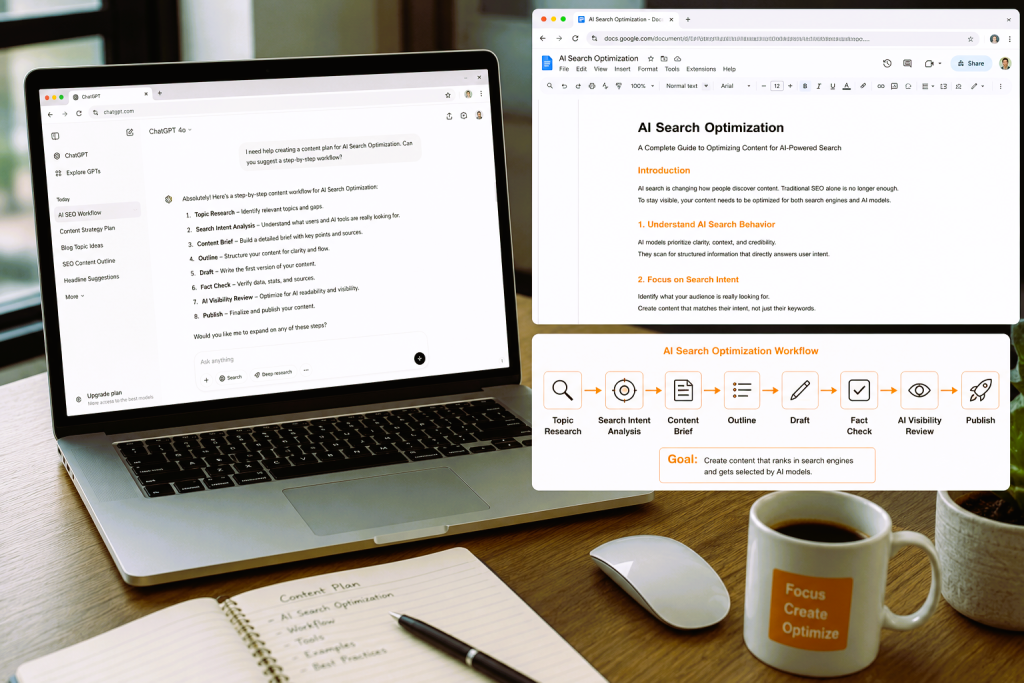
Reading prompts is helpful.
Using them in the right order is what creates better results.
Many marketers make the mistake of opening ChatGPT, typing a short request like “Write an SEO article,” and publishing the response after a few edits.
That approach rarely produces content that stands out.
Instead, treat AI as a strategic assistant throughout your workflow. Each prompt in this guide supports a specific stage of content creation. When combined, they create a structured process that improves quality, consistency, and AI Search Optimization.
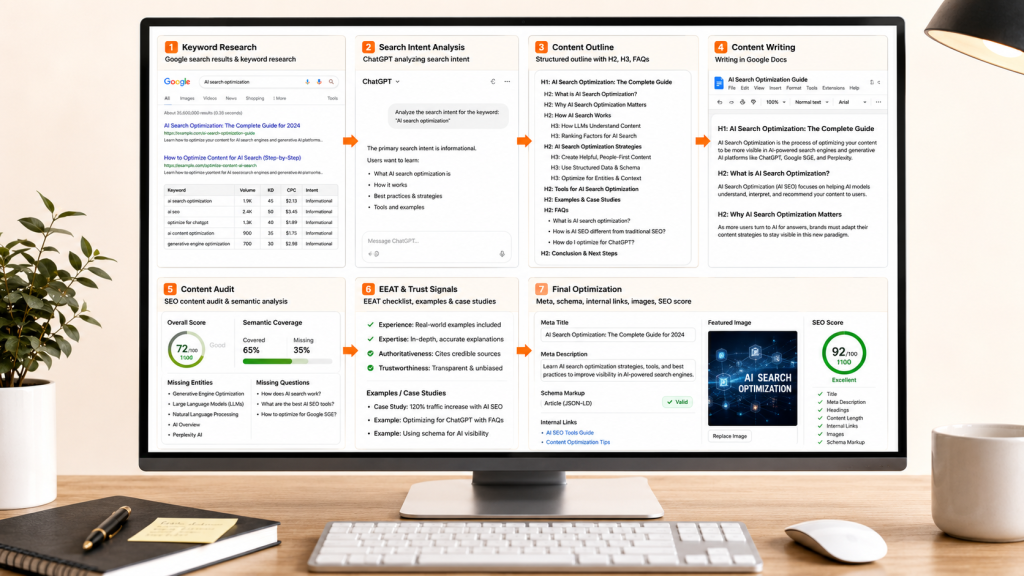
Below is a practical workflow you can follow for every important article.
Step 1: Research the Topic
Start by understanding the topic before writing a single sentence.
Use the keyword research prompts to identify:
- Primary keywords
- Long-tail keywords
- Question-based keywords
- Commercial keywords
- Related entities
Your goal is not to collect the biggest keyword list. Your goal is to understand the language your audience uses when searching for information.
Step 2: Understand Search Intent
Next, identify what users actually want.
Ask questions like:
- What problem are they trying to solve?
- What information do they expect?
- What concerns might they have?
- What action are they likely to take after reading?
Content that matches user intent usually performs better than content written only around keywords.
Step 3: Build a Strong Outline
Never start writing immediately.
Create a detailed outline that includes:
- H2 sections
- H3 subsections
- FAQs
- Examples
- Related entities
- Internal linking opportunities
A clear outline keeps the article focused and prevents important topics from being missed.
Step 4: Create Helpful Content
Now begin writing.
Instead of filling paragraphs with keywords, focus on helping readers solve a problem.
Explain ideas clearly.
Use examples whenever possible.
Answer common questions.
Support important points with practical insights.
Helpful content naturally supports AI Search Visibility because it provides the context AI systems need to understand a topic.
Step 5: Improve Semantic Coverage
Before publishing, review the article again.
Look for:
- Missing concepts
- Missing entities
- Missing examples
- Missing user questions
- Weak explanations
Semantic completeness often separates average articles from authoritative resources.
Step 6: Strengthen Trust Signals
Review the content from a reader’s perspective.
Ask yourself:
- Does this advice sound practical?
- Have I explained why each recommendation matters?
- Are there opportunities to include first-hand experience, original examples, or case studies?
- Have I avoided exaggerated claims?
Strong trust signals benefit both readers and search systems.
Step 7: Optimize the Entire Page
Finally, optimize the page before publishing.
Review:
- Title
- Meta description
- Headings
- Images
- Internal links
- Schema
- FAQ section
Small improvements at this stage often produce meaningful long-term benefits.
Common AI Search Optimization Mistakes
Even experienced marketers sometimes make avoidable mistakes.
Recognizing these issues early can save time and improve content quality.
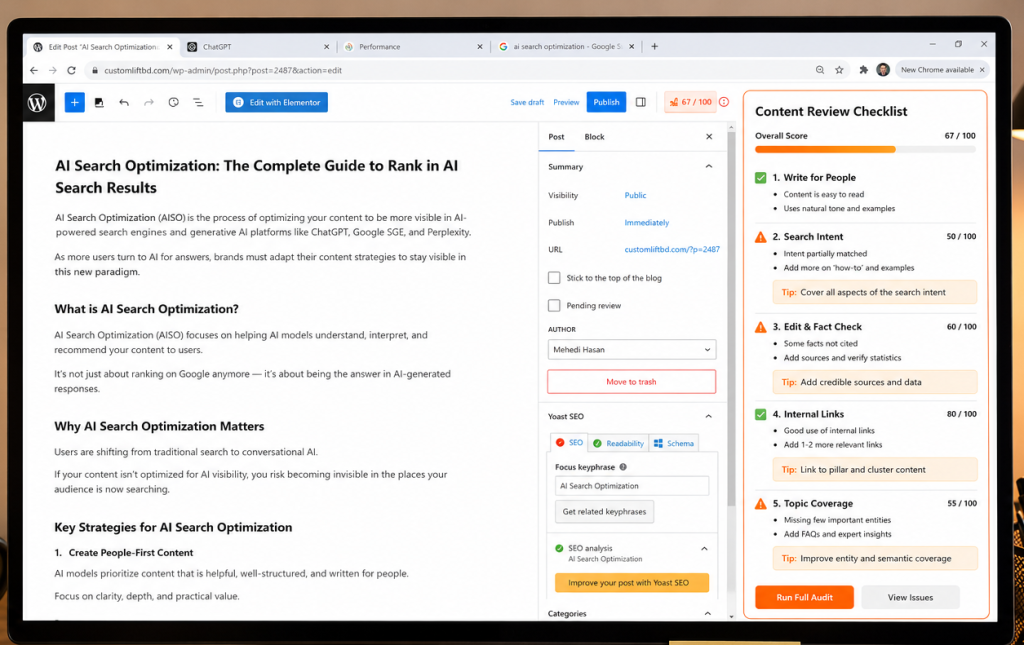
Writing for AI Instead of People
Your first audience is always the reader.
If people find the content useful, AI systems are more likely to understand and recommend it.
Depending on One Prompt
No single prompt can replace a complete workflow.
Use AI to research, organize, review, and improve your work instead of expecting one prompt to generate a finished article.
Ignoring Search Intent
A well-written article can still perform poorly if it answers the wrong question.
Always understand why users are searching before creating content.
Publishing Without Editing
AI-generated drafts should never be published without review.
Check every article for clarity, accuracy, and completeness before it goes live.
Weak Internal Linking
Publishing excellent articles is not enough.
Connect related pages so readers and search systems can easily navigate your content.
Chasing Keywords Instead of Topics
Modern search rewards topic expertise.
Build content around complete subjects instead of isolated keywords.
AI Search Optimization Checklist
Before publishing your next article, review this checklist.
- □ Focus keyword appears naturally in the title and introduction.
- □ Search intent is fully addressed.
- □ Headings follow a logical structure.
- □ Important entities are included where relevant.
- □ Semantic relationships are covered.
- □ Examples improve understanding.
- □ Internal links connect related resources.
- □ Images include descriptive alt text.
- □ Structured data is implemented where appropriate.
- □ FAQ section answers common questions.
- □ Content has been reviewed for clarity and accuracy.
- □ Every recommendation provides genuine value to the reader.
After completing this checklist, the next step is to benchmark your content against today’s AI search best practices. Our guide on How to Win AI Search Results in 2026 walks through the practical strategies that help businesses improve their visibility across AI-powered search platforms.
Treat this checklist as part of your publishing process rather than a one-time exercise.
Optimizing content for AI search is only one part of a modern marketing strategy. Businesses that also adopt AI Agentic Marketing can automate research, personalize customer experiences, and streamline decision-making across the entire customer journey. If you’re interested in applying AI beyond content optimization, our practical guide explores how AI agents can support smarter eCommerce growth.
Final Thoughts
AI-powered search is changing how people discover information, but one principle remains constant: the most valuable content is the content that genuinely helps people.
The prompts in this guide are not shortcuts to guaranteed rankings. They are practical frameworks that can improve research, planning, writing, and optimization. When combined with subject expertise, original insights, and a consistent publishing strategy, they can support stronger AI Search Optimization and broader AI Search Visibility over time.
Instead of searching for a single “magic prompt,” build a repeatable workflow. Understand your audience, answer real questions, strengthen topical authority, and continue improving your content as search evolves.
That approach is far more sustainable than chasing temporary tactics and it positions your website to succeed across both traditional search engines and modern AI-powered search experiences.