A website can look great, load fast, and still lose sales. That gap between traffic and revenue is exactly where a CRO agency earns its keep. A skilled conversion rate optimisation agency does more than test button colours. It uses research, structured experiments, and clear fixes to lift sign ups, leads, purchases, and retention, without spending more on ads.

A CRO agency reviews funnel data and traffic sources to find where visitors drop off.
What a CRO Agency Actually Does (Beyond “Increasing Conversions”)
If you have ever wondered what a conversion optimisation company actually does day to day, the short answer is this: it removes risk from your website. A conversion rate optimisation agency works out why visitors hesitate, where they drop off, and which changes are worth making first.
Typical outputs from a conversion optimisation company include:
- A research-backed testing roadmap, ranked by impact and effort
- UX and messaging updates across your most important pages
- Test design and execution using a proven A/B testing methodology for websites
- Measurement setup, covering events, funnels, dashboards, and QA
- Ongoing reporting and decision support, so you know what is actually working
Many conversion rate optimization companies also run specialised conversion rate optimisation services for eCommerce stores, lead generation sites, SaaS onboarding flows, and mobile apps.
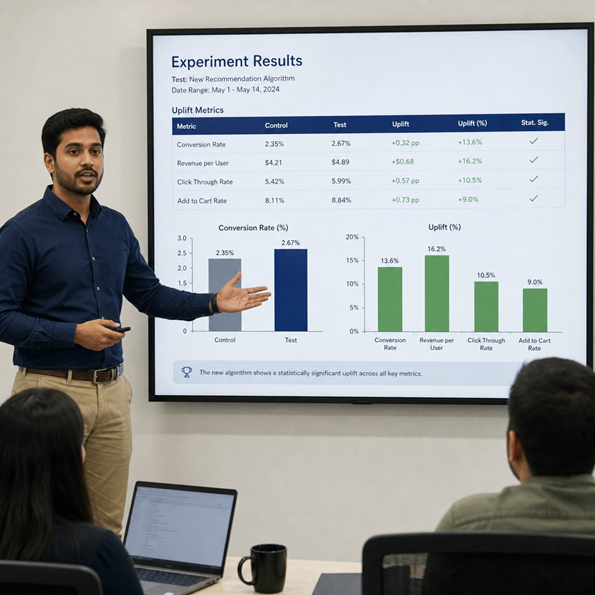
Clear reporting turns test results into decisions the whole business can act on.
CRO vs. UX vs. SEO: Where the CRO Agency Fits
CRO shares ground with UX and SEO, but each discipline has a different job.
- SEO brings the right visitors to your site.
- UX design makes the site easier and more pleasant to use.
- CRO turns the visitors you already have into clear actions, like a purchase, a form submit, a subscription, a booking, or an upgrade.
A conversion agency often sits between marketing, product, and design teams, so improvements actually turn into revenue instead of staying stuck as ideas on a whiteboard.
Core Services You Should Expect from Conversion Optimisation Services
Strong conversion optimisation services usually run in a repeatable cycle: research, hypothesis, test, learn, and scale.
1) Research & Diagnostics (The “Why” Behind the Numbers)
A capable team of conversion rate optimisation experts will not jump straight into testing. They start by understanding friction and motivation first.
Common research methods include:
- Heatmap analysis to understand user behaviour, including clicks, scroll depth, and rage clicks
- Website usability testing, either moderated sessions or self-run tests
- User experience research for conversions, using surveys, interviews, and on-page polls
- Analytics funnel analysis and cohort behaviour
- Session recordings and error monitoring
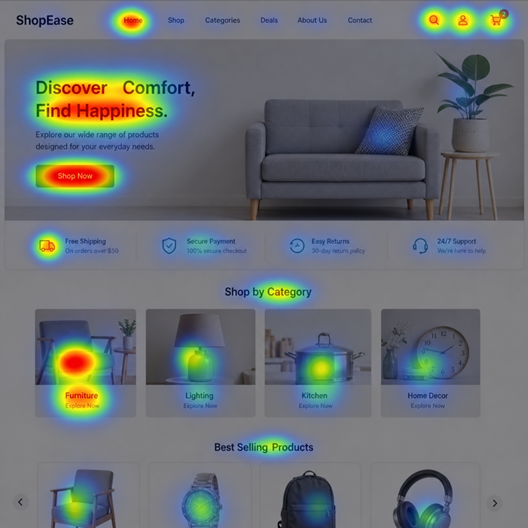
Heatmap analysis shows exactly where visitors focus their attention on the page.
2) Funnel & Page Audits (Finding Leaks Fast)
Most CRO programs start with a structured funnel review. A practical conversion funnel audit checklist usually covers:
- Traffic quality and intent match, checking whether ads or SEO promises line up with the landing page
- Message clarity, including the value proposition, point of difference, and proof
- Friction points, such as long forms, confusing steps, or trust gaps
- Mobile experience and page load performance
- Checkout and payment issues, for eCommerce sites
- Tracking integrity, to confirm events and revenue are attributed correctly
These insights can help businesses identify exactly where visitors are dropping off and how to boost conversion rate through targeted improvements. This is where a conversion rate optimisation company can quickly spot low-hanging fruit before deeper testing even begins.
3) Landing Page Optimization Strategies That Move the Needle
Landing pages often fail because they ask visitors to trust the brand too soon. Effective landing page optimisation strategies usually focus on:
- Stronger above-the-fold clarity, showing who the page is for and why it is better
- More useful proof, such as reviews, logos, case studies, and guarantees
- Better alignment between ad intent and page content
- Fewer competing calls to action
- Improved form UX, including progressive profiling and inline validation
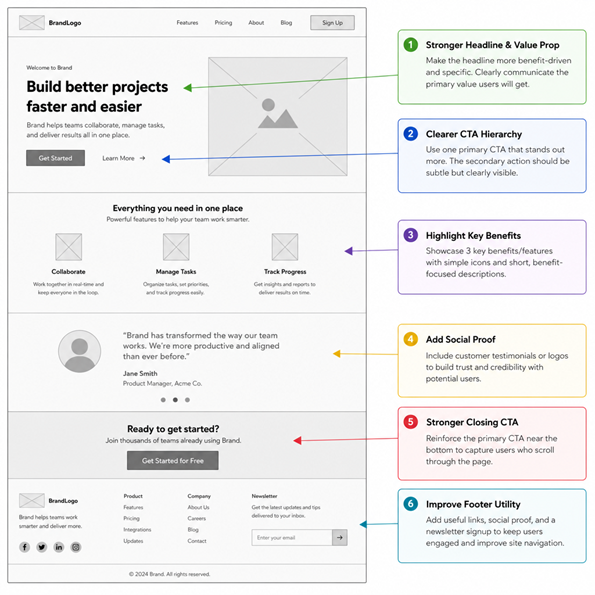
Small, specific changes to a landing page can add up to a meaningful lift in conversions.
4) Experimentation: A/B Tests, Split Tests, and Iteration
A mature CRO program runs on clear test rules, including:
- Hypothesis statements tied to specific user behaviour
- Defined primary metrics and guardrails, such as AOV, refund rate, and churn
- Sample size and duration planning
- Segmentation by new versus returning visitors, device, and channel
- Post-test analysis and a rollout plan for winning changes
In practice, most teams run a mix of A/B and multi-arm tests, though “split testing” is still the term most people reach for. Your partner should be comfortable with split testing tools and software, including experimentation platforms, analytics suites, and feature flag systems, chosen to fit your stack and appetite for risk.
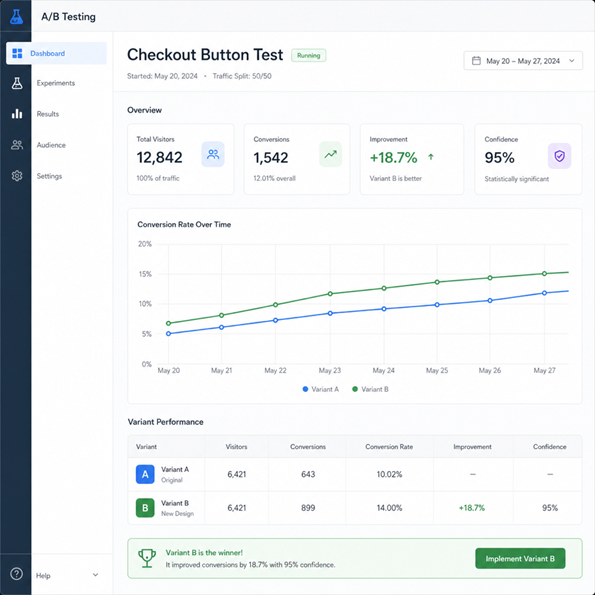
A well-run A/B test gives a clear, statistically confident answer, not just a guess.
eCommerce CRO: Improve Checkout Conversion Rate and Reduce Abandonment
If you are looking for the best conversion optimisation company for eCommerce, ask how they handle checkout complexity, merchandising, and what happens after purchase.
Two of the highest-impact goals for online stores are to improve checkout conversion rate and protect margin while growing volume.
Reduce Cart Abandonment Tactics That Often Work
Effective ways to reduce cart abandonment include:
- Showing shipping costs and delivery times earlier in the journey
- Offering guest checkout, or delaying account creation until after purchase
- Cutting form fields and adding smart defaults, like address autofill and wallet payments
- Reinforcing trust near the payment step with security badges, returns information, and support details
- Using cart recovery messages that match user intent, with helpful information rather than pressure tactics
It is also worth checking for hidden technical causes, like promo code errors, payment failures, or mobile keyboard issues. These quietly hurt conversion and are easy to miss without proper tracking in place.
CRO Pricing Models and Retainers: What You Are Really Paying For
Different CRO pricing models and retainers suit different stages of business growth. The common options are:
- Monthly retainer, the most common model, covering ongoing research, tests, and reporting
- Project-based, for audits, one-off redesign validation, or funnel fixes
- Performance-based, which can look appealing but sometimes creates short-term incentives
- Hybrid, combining a smaller retainer with a bonus tied to agreed outcomes
A reliable conversion rate optimisation agency will define scope clearly, covering:
- The number of experiments run each month, and what counts as one
- The research methods included in the engagement
- Who is responsible for implementation, the agency or your own dev and design team
- Tooling costs, including the testing platform, analytics, and research panels
In-House CRO vs External Consultants: Which Is Better?
The in-house CRO versus external consultants question is less about either or, and more about when and how.
In-house strengths
- Deep product and customer context
- Faster access to internal teams
- Long-term ownership of learning and process
External CRO agency strengths
- Broader pattern recognition across industries
- Dedicated specialists across research, analytics, UX, and experimentation
- Faster ramp-up and proven playbooks
- More neutrality, with less bias toward internal assumptions
A common best of both worlds model is to bring in a CRO agency to build the system first, covering measurement, research, roadmap, and testing cadence, while your team gradually takes over ownership.
Local Search Intent: CRO in Australia (Sydney & Melbourne)
Many Australian businesses look for region-specific expertise, especially when working across time zones or when on-site workshops matter. If you are evaluating conversion rate optimisation Australia, you will notice agencies positioning around:
- conversion rate optimisation Sydney and conversion optimisation Sydney
- conversion rate optimisation Melbourne
- conversion rate optimisation agency Sydney
- conversion rate optimisation agency support across the wider Australian market
Local context genuinely helps here. It shapes audience behaviour, compliance expectations, shipping realities, and how messaging lands with Australian retailers and their customers, whether you are based in Sydney, Melbourne, or anywhere else in the country.
How to Choose a Conversion Optimization Partner (Without Guessing)
If you are researching how to choose a conversion optimisation partner, judge them on process, not just the pitch.
Look for:
- A clear research approach, not just “we will run some tests and see”
- Strong measurement maturity, covering events, attribution, and QA discipline
- A transparent priority framework, whether that is ICE, PIE, or a custom model
- Evidence of learning speed, or how many useful insights they generate each quarter
- Realistic expectations, since CRO compounds over time and is not a magic fix
Questions worth asking a prospective conversion optimisation agency:
- What is your typical testing cadence, and what usually blocks it?
- How do you handle inconclusive results?
- How do you avoid “uplift theatre” wins that never reach revenue?
- Who writes the hypotheses, and who implements the changes?
- How do you make sure accessibility and performance do not regress?
Common CRO Mistakes (And How Agencies Prevent Them)
A solid conversion optimisation company protects you from avoidable traps, such as:
- Testing without enough traffic or time, which creates false winners
- Changing too many things at once, which hides the real cause
- Optimising for clicks instead of revenue or qualified leads
- Ignoring mobile experience and page speed
- Treating CRO as design taste rather than behavioural science
The best conversion rate optimisation services pair structured experimentation with the basics: clarity, trust, less friction, and genuine alignment with user intent.
Practical Next Steps: Start a CRO Program in 30 Days
If you want momentum quickly, a good 30 day plan looks like this:
- Confirm tracking and funnels with an analytics QA check
- Run research, including recordings, heatmaps, surveys, and usability tests
- Complete a funnel and page audit using a conversion funnel audit checklist
- Build a prioritised test roadmap
- Launch one or two high-confidence experiments, often on checkout or your top landing page
- Report on learnings and roll out the changes that win
This is where a conversion rate optimisation agency can make an immediate difference, by building a repeatable system rather than running a single optimisation sprint.
Conclusion: The Real Role of a CRO Agency
The real role of a CRO agency is to steadily turn more of your existing traffic into revenue through research, testing, and continuous improvement. Whether you are hiring a conversion rate optimisation agency in Australia, comparing conversion optimisation services in Sydney, or weighing up conversion rate optimization services globally, prioritise partners who can prove their process, protect data quality, and build a learning engine your business keeps using long after the first tests go live.
At CustomLiftBD, we treat CRO as one part of a bigger growth system, working alongside SEO, tracking, and performance marketing, so every improvement compounds into sustainable revenue growth for your eCommerce business.
Q&A
Question: How is CRO different from SEO and UX, and where does a CRO agency add unique value?
Short answer: SEO brings the right visitors, and UX keeps the site usable, but CRO turns existing visitors into measurable actions like purchases, leads, and sign ups. A CRO agency links marketing, product, and design by using research and testing to find friction, run disciplined experiments, and turn wins into revenue, not just traffic or style.
Question: What should I expect as core deliverables from a credible CRO engagement?
Short answer: Expect a research-backed testing roadmap, UX and messaging updates on key pages, solid A/B or multi-arm test design and execution, proper measurement setup for events, funnels, dashboards, and QA, plus ongoing reporting and decision support. Many agencies also offer specialised programs for eCommerce, lead generation, SaaS onboarding, and mobile.
Question: How do strong CRO programs reduce cart abandonment and improve checkout conversion for eCommerce?
Short answer: They combine UX fixes with technical QA, showing shipping costs and delivery times early, offering guest checkout, keeping forms short with smart defaults and wallet pay, reinforcing trust at payment, and using cart recovery that matches intent. They also look for hidden blockers like promo code errors, payment failures, and mobile input issues that quietly hurt conversions.
Question: Which pricing model should I choose for a CRO agency, and what scope details matter most?
Short answer: Monthly retainers fit ongoing programs, projects work for audits or focused fixes, performance-based plans can misalign incentives, and hybrids blend both. Whatever you choose, define the number of experiments per month, the research methods included, who implements changes, and the tool costs for testing, analytics, and research.
Question: When is it better to use an external CRO agency versus building in-house?
Short answer: It is not either or. In-house teams win on product context, fast access, and long-term ownership. External agencies bring cross-industry pattern recognition, specialist depth, faster ramp-up, proven playbooks, and neutrality. A common best of both model is to have an agency set up measurement, research, roadmap, and cadence, then hand more ownership to your team over time.